
Two Founders. One Wrong Move Each.
Rajan shipped his MVP after four months of building. Day one, he had signups. Day three, he had feedback. By day fifteen, he had pivoted - scrapping his core feature because three users said it was confusing.
Priya shipped hers around the same time. She had traction - not much, but real. A small group of users who came back every day. She ignored them and started scaling acquisition. Six months later, she had thousands of users and a product none of them loved.
Two founders. Both shipped. Both failed. Not because their ideas were wrong - but because they made the two most common post-launch mistakes: Rajan pivoted before he understood what he had. Priya scaled before she knew if it worked.
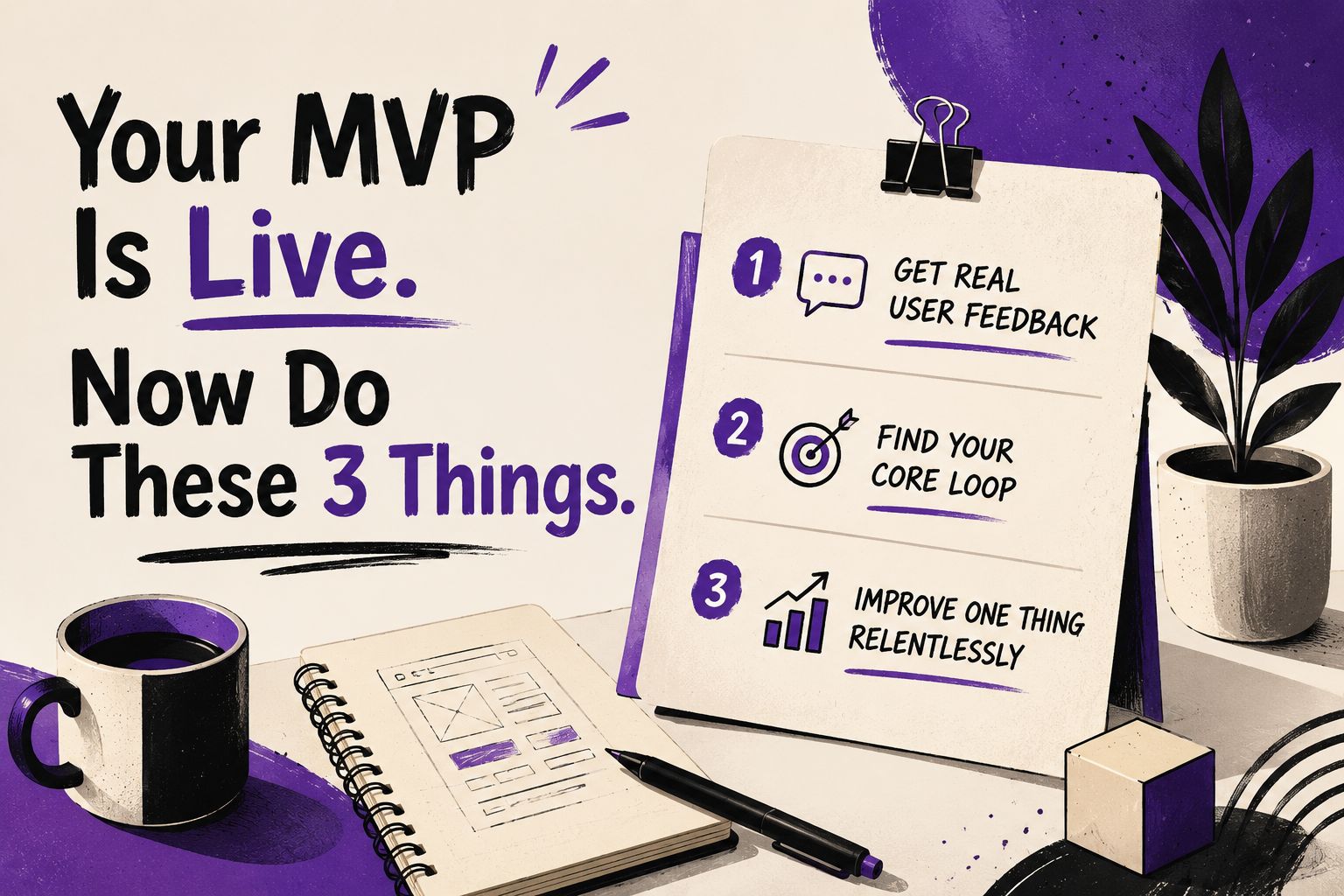
The 30 days after your MVP goes live are the most important and most misunderstood phase of building a product. This is not the time to pivot. It is not the time to scale. It is the time to do three specific things - and almost nobody does all three.
Thing 1 - Read Your Team Before You Read Your Metrics
Here is what nobody tells you after launch: the first thing that breaks is not your product. It is your team.
The MVP was built under pressure, with unclear roles, a shared Notion doc, and the kind of energy that only exists when you are trying to prove something. That energy does not automatically carry into what comes next. Post-launch, the team needs direction - and if the founder cannot provide it, the product stalls regardless of what the dashboard says.
Ben Horowitz writes in The Hard Thing About Hard Things that the founder-CEO's job description changes almost completely every six months. Most founders do not grow with it. They keep doing what got them to launch - building, pushing, deciding alone - when what the team now needs is a different kind of leadership. Someone who can translate user feedback into priorities. Someone who can keep a co-founder from losing faith when the numbers are flat.
Take care of the people, then the product, then the profits - in that order.
The founders who make it past this phase are not always the ones with the best product. They are the ones who looked at their team first and asked: are we set up to learn from this launch, or just to survive it?
One question to ask your co-founder this week: what do you think we got wrong in the build, and what do you want to do differently now? If the answer surprises you, that is information. If there is no honest answer, that is a bigger problem than your retention rate.
Thing 2 - Find the Signal in the Noise
Most founders look at the wrong numbers after launch. Downloads. Signups. Page views. These tell you how many people arrived - not whether any of them stayed because they needed what you built.
The number that matters is not how many people signed up. It is how many of them would be genuinely upset if you shut the product down tomorrow.
Sean Ellis, who helped grow Dropbox and Eventbrite, tested this across 100+ startups. His finding: if 40% or more of your early users say they would be very disappointed to lose your product, you have a real signal. Below that threshold, you are not ready to scale - you are still in the validation phase, whether you know it or not.
Airbnb's founders understood this before they had any data to back it up. After launching, they flew to New York - where most of their users were - and went door-to-door. They took photos of listings themselves. They sat with hosts and asked what was not working. Bookings did not jump because of a new feature or a marketing push. They jumped because the founders listened to a small group of real users and fixed the exact friction those users described.
The three signals that actually matter post-launch:
Retention - are users coming back without being prompted?
Depth of use - are they using the core feature, or just the onboarding?
Organic spread - are they telling anyone?
You do not need a data team to track these. You need honest conversations with your first 20 users. Call them. Not a survey - a call. Ask what brought them back and what almost made them leave. The answer to those two questions is worth more than any dashboard.
Thing 3 - The Pivot or Scale Decision
This is where most founders get it wrong - and the consequences are expensive either way.
According to the Startup Genome Project, premature scaling kills 70% of startups that grow before validating their core model. These companies have 20 times lower growth rates and are three times more likely to never exit. And yet the pressure to scale is real - investors want to see growth, the team wants momentum, and every week that passes feels like a week behind.
On the other side: 42% of startups fail because there is no real market need for what they built. That number includes founders who pivoted away from something that was working because they panicked when early traction looked small.
Rovio made 51 games before Angry Birds. For six years, they built, shipped, and failed. Near bankruptcy in 2009, they did not pivot away from gaming - they went deeper, sharper, and more focused. Game 52 was downloaded three billion times. The difference was not a better idea. It was the discipline to stay in the problem long enough to solve it properly.
The one question that tells you which move to make:
Do I have a small group of users who genuinely need this - or do I have a large group of users who kind of like it?
If you have the first, do not pivot. Double down. Learn everything about those users, build exactly what they need, and resist every urge to widen your scope before you have made them love you. That is the foundation of everything that comes next.
If you have the second - lots of users, no depth, no retention - stop acquiring. Go back to the signal. Find the subset who actually came back, and ask them why. The pivot, if you need one, should come from that answer - not from a board meeting or a competitor announcement.
Crossing the Chasm by Geoffrey Moore draws a sharp line between early adopters and the mainstream market. Most post-MVP products die in the gap between them - not because the product was wrong, but because the founder tried to cross before they had earned the right to.
As Peter Thiel argues in Zero to One: if your MVP has found something no one else has, do not pivot away from it - double down and build the monopoly.
The Founders Who Make It Past This Phase
They are not always the smartest people in the room. They do not always have the best product at launch. What they have is the discipline to slow down at exactly the moment when everything in their environment is telling them to move fast.
They read their team before they read their metrics. They find the real signal before they chase growth. And they make the pivot-or-scale decision based on evidence - not on pressure, not on fear, and not on what their competitor just announced.
Every growing product is an outcome of the growth journey of the people who built it - the founder included. The 30 days after launch do not just reveal whether your product works. They reveal whether you are the kind of founder who can take it further.
Pythrust works with founders at exactly this stage - the messy, important period between launch and product-market fit. If you are trying to figure out what to do next, we can help you read the signals, make the right call, and build what comes after the MVP.
Ready to figure out your next move? Book a call with Pythrust and let us help you build what comes after the MVP.