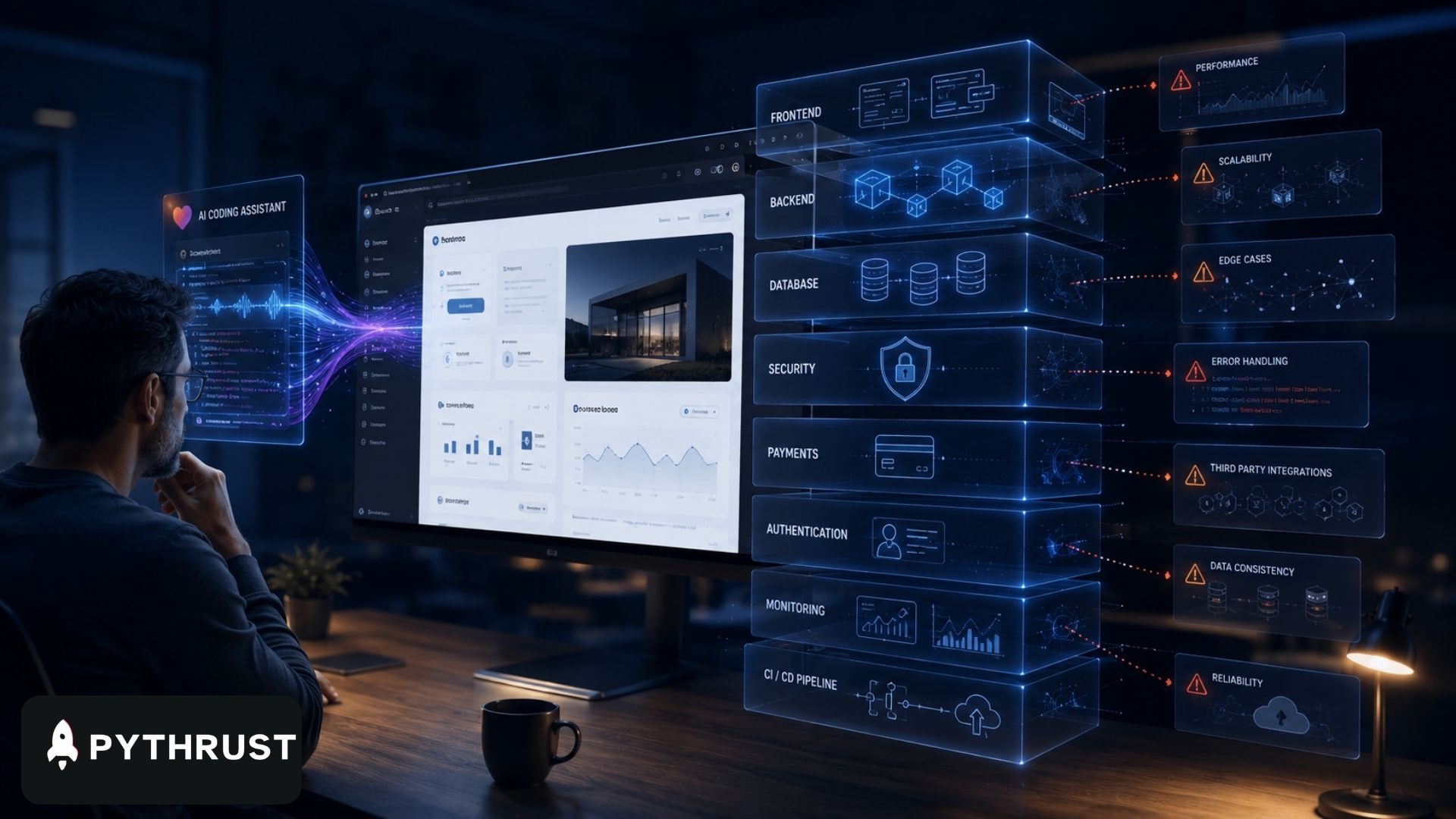


1. The Intoxication of the Modern Interface
The narrative dominating the software ecosystem right now is incredibly powerful, pervasive, and dangerously misleading: software engineering is dead.
Step into any early-stage startup hub, browse LinkedIn, or open X, and you will find an ecosystem completely transformed by a new breed of technology. Armed with next-generation AI application builders and agentic text-to-code platforms like Lovable, Bolt.new, v0, and Cursor, non-technical founders are building complete, interactive web applications over a single weekend.
For the first time in the history of computer science, typing a natural language prompt bypasses the syntax barrier entirely. You type your intent, a machine interprets the instructions, and a functioning platform appears on your screen. You can click custom buttons, navigate responsive dashboards, authenticate users, and populate real databases.
The hard truth is that you don't. What you have generated is a highly polished, interactive visual prototype, not a resilient production asset.
A real software product is not simply a static collection of AI-generated files hosted on a cloud server. It is an active, evolving, and highly complex system that must survive real-world user behaviors, malicious security exploits, intense concurrent data loads, and constant structural updates from third-party APIs.
AI builders are brilliant at generating raw scripts; they are fundamentally incapable of providing the operational engineering team required to sustain it over a product lifecycle.
"Vibe Coding" lowers the cost of entry, but it leaves behind a massive mountain of hidden architectural debt that eventually defaults the moment your first hundred customers sign up.
2. The Great Realignment of Vibe Coding
This technological shift did not happen in a vacuum. It represents a fundamental macroeconomic realignment in how software is created. Following the explosive rise of large language models, the tech world entered what historians and computer scientists call the 2025 "Vibe Coding" Realignment Era. Coined by computer scientist Andrej Karpathy, the term perfectly describes a new paradigm where a person programs purely by "setting a vibe"—using natural prose to dictate system behaviors while the machine manages the underlying execution.
That is not a marginal improvement in developer tools. That is a structural shift in what it means to be a founder.
According to community and network analysis from Y Combinator Startup Insights, an astonishing 81% of YC startups now actively utilize AI builders within their workflows, and roughly 25% of recent cohorts rely almost entirely on AI-generated code to launch their initial MVPs.
For non-technical founders, this era offers three distinct advantages that were previously locked behind massive capital walls:
Velocity to Validation: You can test real market demand and collect early user feedback before spending your life savings or raising institutional capital.
Equity Preservation: You no longer have to immediately hand away 30% to 50% of your equity to attract a technical co-founder just to see if your idea can technically exist.
Fundraising Signal: Institutional seed investors who see working, interactive platforms offer significantly higher valuations than those who walk into a room with nothing but static presentation slides and wireframes.
But this velocity comes with a massive catch. While AI tools have reduced the mechanical burden of typing syntax, the structural burden of software engineering remains unchanged.
The initial industry hype—which boldly claimed amateur prompt engineers would completely phase out professional software development teams—has rapidly evolved into a widespread realization that unmanaged AI outputs disintegrate under real-world operational pressure.
3. The Illusion of Validation
The euphoria of the first 48 hours of using an AI builder is entirely unmatched. You spend $20 on an LLM subscription and effortlessly accomplish what used to require ₹5 Lakhs to ₹10 Lakhs in capital, three months of intense agency negotiations, and endless developer interviews.
The prototype runs flawlessly in your isolated browser preview or your local sandbox environment. It fetches data, responds instantly to your inputs, and renders beautifully. It is deeply human to assume that if it works perfectly on your machine, it is ready to handle real, paying enterprise clients.
This is exactly where the strategic trap snaps shut.
Traditional software engineering is slow and methodical not because typing code is fundamentally hard, but because making software resilient to the chaotic, unpredictable nature of the real world is deeply complex. AI builders optimize entirely for the speed of visual completion. Their internal reward models prioritize making a feature appear on your screen as fast as possible so you keep prompting.
To achieve this instant gratification, the AI cuts critical engineering corners beneath the surface. It delivers a gorgeous, gleaming facade built on top of a fragile foundation of unoptimized logic.
The moment you shift an application from an isolated developer sandbox to live, concurrent user traffic, the application transitions from an exciting startup asset to an unpredictable operational liability.
4. What AI Builders Generate vs. What a Product Requires
Non-technical founders see a working interface; software engineers see the completely vacant engineering pipeline behind it. When an AI tool drafts an application, it works in a clean, theoretical vacuum.
According to frameworks established by McKinsey & Company Tech Insights, software maturity moves across clear phases. While AI excels at Level 3 developer assistance—generating isolated components and visual layouts—moving into a sustainable, production-grade system requires rigorous structural layers that AI systems routinely skip.
There are four essential operational layers that AI builders generate poorly, or omit completely, that a dedicated human engineering team must actively manage:
State Management & Scaling
An AI builder knows how to make a single user path work beautifully. However, it lacks the systemic foresight to design complex state management. When 500 users execute actions, read records, and push data updates simultaneously, an unarchitected app will experience state desynchronization, leading to corrupted records, session mix-ups, and systemic database lockups.
Security & Data Isolation
AI tools focus on the front-end user experience, meaning they routinely place data validation and business rules on the client-side rather than behind a secure server wall. Without expert human configuration, it is shockingly easy for a malicious actor—or even an accidental user mistake—to exploit these flat data models to query and access the private data records of other users.
Cost-Optimized Cloud Architecture
An AI builder does not care about your cloud infrastructure bill. If it needs to display a list of user profiles, it will often generate an unoptimized, brute-force query that repeatedly polls your database. While this inefficiency is completely invisible during a solo local demo, live user traffic will amplify these unoptimized calls exponentially, leading to severe system lag and devastating cloud bills.
Observability & Error Logging
When a production system inevitably encounters an edge case error in the wild, an engineer relies on structured logging and observability metrics to trace and fix the root cause immediately. AI-generated applications are notoriously silent. When they crash for a high-value customer, they leave no forensic trail, leaving the non-technical founder completely blind to why their retention rate is plummeting.
5. The Structural Breakdown of the AI-Generated Codebase
To truly understand why an AI-built application resists scaling, you must look directly at the structural divergence between code that is generated and architecture that is engineered. According to an extensive research paper published in the ArXiv Tech Repository / Cornell University tracking software systems built with generative tools, AI models introduce an accumulation of complex technical debt that degrades repository health over time.
1. The Context Window Limitation
AI models operate within strict token and context limitations. As your application inevitably expands from 5 basic files to 50 interdependent modules, the underlying AI builder can no longer read or hold your entire software architecture in its active memory. It begins writing net-new features based entirely on localized assumptions.
According to enterprise analysis from Anthropic Developer Systems & Research on context engineering, treating application building as a sequence of isolated prompt windows triggers severe "context rot." In adding a new button or payment field to file A, the AI silently deprecates or breaks vital routing logic buried deep within file B.
2. The Recursive Hallucination Loop
When an unexpected bug surfaces, the natural instinct of a non-technical founder is to copy the terminal error, paste it back into the prompt box, and click fix. Because the AI lacks a holistic mental model of the product, it applies a quick, superficial patch to fix the immediate symptom rather than resolving the core architectural flaw.
This localized patch inevitably introduces a secondary conflict in a neighboring module. The founder prompts the AI to fix the new error, which creates a third conflict. Within a few iterations, you enter a recursive hallucination loop—stacking patch upon patch, turning your entire repository into an unmaintainable house of cards that no engineer can decipher.
3. Unoptimized Database & API Consumption
AI platforms focus purely on functional appearance, not operational efficiency. They frequently write redundant logic blocks because they don't know how to refactor existing code. A data call that a human engineer would consolidate into a single, elegant query is frequently written by an AI as an iterative loop that hammers the database server thousands of times.
Data compiled in the Larridin Industry Benchmarks 2026 shows that due to these unoptimized recursive loops, the token consumption and cloud infrastructure spend for agentic building tools frequently scales to $200 to $2,000+ per user per month, causing sudden, staggering billing shocks for early-stage setups.
4. The Complete Absence of Regression Testing
A software asset can only survive continuous updates if it is backed by an automated test suite. These tests run silently in the background, checking every single line of code during a deployment to ensure that a new feature update hasn't accidentally broken existing parts of the platform. AI builders do not inherently architect, write, or execute these regression test suites. Every time you issue a prompt to update your app, you are gambling blindly with your entire customer experience.
6. The Heavy Lifting of Data: The Churn Crisis
The structural instability of AI-generated code isn't just an anecdotal complaint from frustrated engineers—it is a statistically proven phenomenon backed by massive, longitudinal data sets.
A multi-year global code quality study analyzing over 153 million changed lines of production code, published by the GitClear Code Quality Longitudinal Study, reveals an alarming trend in software maintainability. Code churn—defined as the percentage of authored code lines that are completely deleted, rewritten, or reverted less than two weeks after being pushed to a repository—has surged from a historic pre-AI baseline of 3.3% up to 5.7%–7.1%.
This data proves that AI engines are aggressively writing repetitive code rather than modularly refactoring existing architectures. The research notes a drastic drop in code reuse and an eightfold increase in duplicate code blocks across repositories.
Furthermore, data tracking systemic architecture trends from the Thoughtworks Technology Radar Briefings isolates this exact failure point, defining it as "Codebase Cognitive Debt." When founders build without a human-in-the-loop engineering structure, they accumulate massive cognitive debt—creating dense, winding code patterns that are impossible to reason about, secure, or scale without professional intervention.
7. The Low-Code Parallel
If this story feels familiar, it is because the technology ecosystem has lived through this exact lifecycle before. The current wave of generative AI tools perfectly mirrors the trajectory of the Low-Code/No-Code Ceiling Realignment of the mid-2010s.
When platforms like Bubble, Webflow, and AppSheet first achieved mainstream adoption, the tech community echoed the exact same predictions we hear today: the era of the software developer is over, visual interfaces have won, and anyone can scale an enterprise solo.
Within 24 months of launching, every single no-code startup that achieved meaningful market traction hit an invisible structural ceiling. They found themselves severely constrained by database concurrency limits, completely unable to pass rigorous corporate security reviews, and bleeding cash due to unoptimized API connections.
The companies that survived and transitioned into sustainable enterprises did so by executing a strategic pivot: they hired managed engineering teams to systematically extract their visual prototypes and rebuild them into securely engineered, production-ready codebases. The exact same law of software gravity applies to AI-built apps today.
8. The Four Mistakes That Kill AI-Generated Apps
In reviewing hundreds of MVPs built using modern agentic tools, we have isolated four consistent mistakes that routinely derail non-technical founders:
Mistake 1: Visual Complacency
Assuming that because the interface looks spectacular, the underlying architecture must be secure. AI is a world-class designer but an unprincipled architect.
Mistake 2: Scaling Naivety
Treating an AI prototyping engine as an infinite scaling solution. Forgetting that AI cuts deep structural corners to deliver instant visual results to your prompt.
Mistake 3: Launching Without an Independent Code Review
Treating a software repository like a static text document rather than an interconnected machine with moving parts, dependencies, and memory constraints.
Mistake 4: Ignoring Total Cost of Ownership (TCO)
Failing to account for massive API token inefficiencies, catastrophic cloud infrastructure costs, and the hundreds of lost founder hours spent managing code instead of managing customers.
The macro data compiled in the McKinsey State of GenAI Corporate Data Briefing brings this reality into sharp focus. While over 80% of organizations have aggressively piloted generative text-to-code builders within their infrastructure, only a tiny 5.5% of enterprises have successfully captured measurable bottom-line value.
The elite 5.5% who find success do so because they understand a fundamental truth: AI tools should be utilized for initial prototyping speed, but real-world financial returns require strict human-led architectural governance.
9. Technical Risk Assessment Questions for the Founder
If your startup is currently relying on an application built entirely through unreviewed AI prompts, you are operating with a significant blind spot. Run your product through this rapid, objective technical risk assessment:
Concurrency Latency: Does our application response time slow down dramatically the exact moment multiple users attempt to execute actions at the same time?
Schema Evolution: How do we safely alter or expand our live database structures without corrupting or completely wiping out our existing user profiles?
Hallucination Breakout: When our AI builder enters a loop and continuously generates the exact same broken code block, do we have the internal capacity to manually refactor the repository?
Transaction Isolation: Are our payment gateway webhooks, authentication tokens, and state parameters securely hidden behind server-side firewalls, or are we structurally exposed to fraud?
If you cannot confidently navigate your source repository and answer these questions with mathematical precision, you do not own a software asset. You own a fragile technical experiment.
10. Savvy Founders Accelerate with a Managed Team
The most successful non-technical founders operating in this era are neither anti-AI nor are they fully reliant on it. They do not reject the power of modern tools; instead, they respect them for exactly what they are: world-class validation instruments, rapid prototyping engines, and immediate user-interface rendering environments.
But the precise milestone they validate clear market demand and acquire their first cohort of users, they intentionally change their operational model.
They hand that prototype over to an elite technical team. They refuse to spend their highly valuable founder hours playing amateur prompt engineer at 2 AM, wrestling with incomprehensible terminal bugs, or debugging database timeouts. Instead, they redirect their unique founder energy toward the strategic levers that no AI can execute for them: distribution, strategic positioning, customer acquisition, investor relations, and enterprise sales.
The window to launch an AI prototype has never been wider, but the window to scale one into a viable business requires real, uncompromised technical guardrails.
11. Don't Build Alone. Talk to Pythrust.
You do not need to discard the valuable progress you have made with your AI builder, and you do not need to hire a slow, bloated, traditional software development agency that wants to charge you lakhs just to scrap your vision and start over from scratch.
Pythrust offers the definitive third path: a Managed Build framework architected specifically for AI-driven founders.
You bring us your Bolt.new, Lovable, v0, or Cursor prototype. Our veteran engineering team executes a comprehensive, line-by-line architectural audit. We systematically patch your critical security vulnerabilities, optimize your data structures to slash your cloud infrastructure bill, insulate your user records, and implement the automated regression testing suites required to make your product completely production-ready.
We act as your elastic, institutional technical team—ensuring your software remains stable, scalable, and hyper-secure, while you focus 100% of your power on growing your market share.
Stop playing prompt wrangler. Let's build a software asset that lasts.
[Book a free 30-minute Prototype Review Consultation with Pythrust.]