
The Brutal Truth About Startups
90% of startups fail. 42% fail because they build products nobody wants. Only 10% of new businesses survive their first year. In 2024 alone, 966 startups shut down—a 25.6% increase from the previous year.
These aren't just statistics. They're warnings.
The founders who fail often share the same story: they spent months (sometimes years) building in isolation, burned through their capital perfecting features, and launched to crickets. By the time they realized they'd built the wrong thing, they had no runway left to pivot.
The winners? They launched something "bad" quickly, learned from real users, and iterated their way to product-market fit while they still had resources.
The YC Philosophy: Launch Something Bad Quickly
Y Combinator's Michael Seibel has coached hundreds of successful startups, and his advice is counterintuitive: "Launch something bad quickly." Not because bad products succeed, but because you only start learning when real users interact with what you've built.
Successful companies like Airbnb, Twitch, and Stripe started with extremely simple MVPs and iterated based on user feedback. Airbnb's first version had no payment processing—hosts and guests exchanged money in person. Twitch launched with just one channel streaming one person's life. Stripe's early version required founders to physically come to their office to integrate it.
All billion-dollar companies. All started with something "shitty."
The pattern is clear: You only really start learning about your users when you put a product in front of them—not by doing 1,000 surveys, gathering a mailing list, or fundraising for half a year.
Why 90 Days Is Your Timeline
Time is the most precious resource for an early-stage startup. Every day you delay launch is a day you could be learning from real users and iterating toward product-market fit.
The data supports aggressive timelines:
- Capital efficiency: Development costs have dramatically decreased. What once required $100,000-$200,000 and 6+ months can now be accomplished at a fraction of that cost in 90 days or less
- Validation speed: 20% of startups fail within the first year. The faster you validate (or invalidate) core assumptions, the more time you have to adapt
- Momentum: Once something is out in the world, the momentum to keep going is extremely strong
Most importantly, 90 days forces you to cut everything that isn't essential. It's a constraint that breeds clarity.
The 90-Day Framework
Week 1-2: Talk to Users Before You Build
The three key steps for a pre-launch startup are: launch quickly, get some initial customers, and continuously gather feedback from users to improve the product.
But before you build anything, you need to understand the problem deeply.
Customer Discovery (Not Surveys)
Don't ask people if they'd use your product. It's a lot harder to learn from your customers when they don't have a product they can play with. Instead:
- Identify who has the problem you want to solve
- Talk to 15-30 people who experience this pain point regularly
- Ask about their current behavior, not hypothetical preferences ("How do you solve this today?" not "Would you use my solution?")
- Look for patterns in how they describe the problem and their failed attempts to solve it
If you're your own user—even better. You can test immediately and get instant feedback.
Define Your Riskiest Assumptions
What needs to be true for your business to work? Write down:
- Problem hypothesis: This specific group of people has this specific problem
- Solution hypothesis: Our approach will effectively solve this problem
- Willingness-to-pay hypothesis: People will pay $X for this solution
Your MVP's sole job is to test these assumptions as quickly as possible.
Week 3-4: Plan Your MVP (Ruthlessly Simple)
An MVP should be built quickly in weeks, not months, and can be in the form of a simple website, landing page, or spreadsheet.
The Timebox Strategy
If you choose an arbitrary date to launch—say in 3 weeks—this is a forcing function to cut anything that isn't essential.
Here's how:
- Set a deadline: 3 weeks from today
- Write down your feature list: What do you think your MVP needs?
- Cut 50% immediately: Be honest—half of those features aren't essential
- If you still can't hit the deadline, cut more: If there are no "non-important" things, start cutting important things
The "Limited Functionality" Rule
Your MVP should solve ONE core problem for ONE specific group of users. That's it.
- Airbnb: Book a room in San Francisco during a design conference (no payments, no global reach, no professional photos)
- Twitch: Watch Justin.tv's founder live his life (one channel, no gaming, no community features)
- Stripe: Process online payments if you came to their office (no self-service, minimal integrations)
It's far better to have a hundred people love your product than a hundred thousand who kind of like it.
Write It Down
If your set of features for your MVP isn't written down, it's really easy to add features that aren't essential. And you might not even realize you are doing it!
Create a simple spec document:
- Core problem being solved
- Target user (specific person/persona)
- Must-have features (3-5 maximum)
- What's explicitly NOT included
Week 5-8: Build Your MVP
Choose Your Approach
There are two types of MVPs:
Lean MVP (Most Startups):
- Build in weeks, not months
- Can be as simple as a landing page + spreadsheet
- Limited functionality solving the core problem
- Small set of initial users
Heavy MVP (Regulated/Hardware):
- For industries like fintech, healthcare, biotech, aerospace
- Still start with the simplest possible version
- Begin with a website explaining what you're building
- Use it to have conversations and get feedback
Modern Tools Accelerate Everything
The technology landscape has transformed MVP development:
- No-code platforms enable non-technical founders to build functional products
- Low-code tools allow rapid prototyping with custom logic
- AI-assisted development accelerates coding, documentation, and testing
- API-first services mean you don't rebuild common functionality (payments, auth, email)
What used to require a full engineering team can now be accomplished by lean teams leveraging modern tooling.
Focus on the Problem, Not the Tech
Don't get distracted by:
- Perfect visual design (polish comes later)
- Scalability concerns (worry about scale when you have users)
- Every edge case (handle the happy path first)
- Impressive tech stack (use what gets you to launch fastest)
Week 9-10: Pre-Launch Polish
Just Enough Quality
The initial version may not be perfect, but feedback can guide further iterations to build a successful product that solves the user's problem effectively.
Your MVP needs to be good enough that early adopters will actually use it. But remember:
The people who are interested in talking to a startup are early adopters. They're used to using products that don't work very well, and they're talking to you because they have a real problem and they're open to using new software.
Early adopters forgive rough edges. They won't forgive:
- Broken core functionality
- Confusing user experience
- Unclear value proposition
- Ignoring their feedback
Set Up Feedback Loops
Before launch, implement:
- Simple analytics (what users actually do vs. what they say)
- Easy way for users to report bugs
- Method to schedule follow-up conversations
- System to track which features get used
Week 11-12: Launch and Get Your First Users
The Myth of the Big Launch
Launches aren't special at all. Do you remember the day that Google launched? How about Facebook? How about Twitter?
Your goal isn't TechCrunch coverage. It's getting ANY users interacting with your product.
Where to Find Your First Users
The first users can be acquired by talking to people who have the problem that your product aims to solve. If you know someone who has the problem, they can be your first user.
Reach out to:
- People from your customer discovery interviews who expressed strong interest
- Your personal network (if they have the problem)
- Online communities where your target users congregate
- Direct outreach to individuals who fit your ideal user profile
The "Do Things That Don't Scale" Phase
Stripe founders personally integrated their product for early customers. Airbnb founders photographed homes themselves. You should be equally hands-on.
This isn't sustainable long-term. That's okay. You only really start learning about your users when you put a product in front of them.
The Iteration Engine
The Real Work Begins After Launch
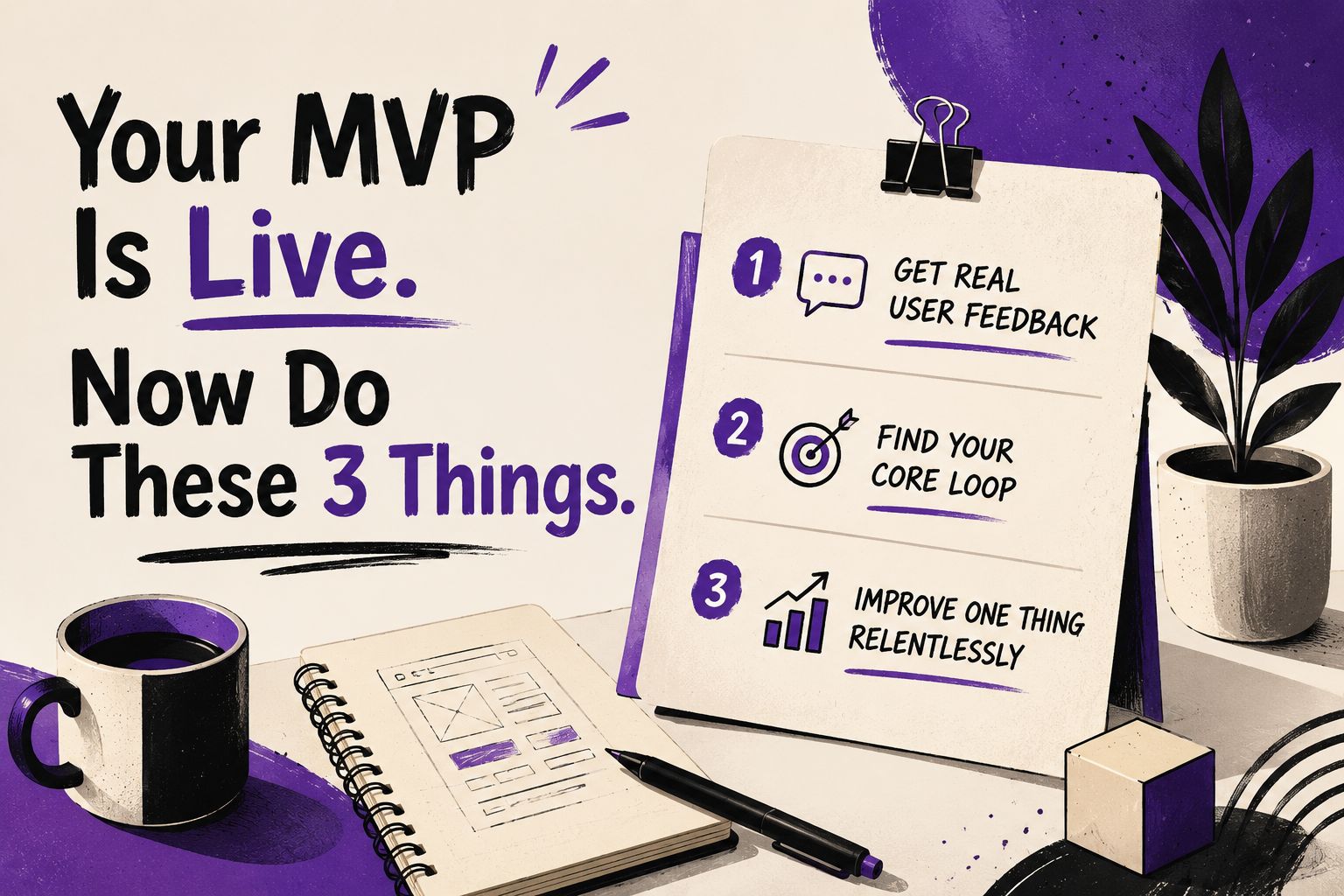
After launching your MVP, actively engage with your users and gather feedback. Don't dismiss feedback on the initial version just because it's not the full solution.
Your post-launch cycle:
- Talk to users: What were they trying to accomplish? Did your product help?
- Iterate product: Make changes based on what you learned
- Talk to more users: Did the changes improve things?
- Repeat continuously
After 3-6 iterations, your MVP will be completely different. You'll have learned exponentially more than just talking to co-founders or theorizing.
Hold the Right Things Tightly
Hold the problem you're solving tightly, hold the customer tightly, hold the solution you're building loosely.
This is the most important principle in MVP development.
What to hold tightly:
- The problem you're solving
- The customer segment experiencing that problem
- Your commitment to helping them succeed
What to hold loosely:
- Your specific solution
- Your feature roadmap
- Your initial assumptions about what they need
Iterate, Don't Pivot
Iterating is changing the solution to the problem. Pivoting is changing the problem you are solving.
Example: If the problem is "I need to screw something in" and the user is a mechanic:
- Iterating: Your screwdriver doesn't work, so you improve the screwdriver
- Pivoting: You decide to solve a completely different problem for a different user
Stay focused on your problem and user. Change your solution until it works.
Don't Fall in Love With Your MVP
You want to fall in love with your customer, with your user—not in love with the crappy initial product that you're building to start learning from that user.
You wouldn't fall in love with a paper you wrote in 1st grade. That's the level of impact/stage of iteration your MVP is.
Your MVP is a conversation starter, not your masterpiece.
Common Fears and How to Overcome Them
"What if my MVP is rubbish and customers never want to talk to me again?"
Even the biggest startups had this same fear. YC deals with it every time. It's okay that you feel this fear. But never act on it.
Reality check:
- If one customer doesn't like your product, that doesn't kill your startup
- You can reach out to another customer
- You can reach out to the same customer after improving the product
- Early adopters try new products all the time—they won't disappear after one bad experience
It's not bad to feel the fear, but it is bad to act on it. It is bad to spend one year building your MVP because you're afraid the first customer might not like it.
"I need to build my full vision or it's pointless to get feedback"
Wrong. Your MVP might not even work how you want it to. But that's a good thing. It means you've been listening to your customers.
The "full vision" is flexible. It might turn out your full vision isn't what customers want. Better to learn that early when you still have resources to adapt.
"I'm not ready to launch yet"
You're never fully ready. Launch quickly. (MVP) Get your first customers.
Many founders want to build a product (like the iPhone) that blows people out of the water at once. That's a very steep hill to climb though. The MVP approach is best.
The Resource Reality Check
Let's talk about what this actually costs and what your options really are.
Understanding Modern MVP Economics
Development costs have decreased dramatically, but the choices you make about how to build determine both your speed and your odds of success.
The Three Paths:
Path 1: Build In-House Team
- Timeline: 12-16 weeks (8-12 weeks recruiting + 4+ weeks building)
- Estimated cost: $100,000-$150,000 for 90 days
- Hidden costs: Management overhead, benefits, infrastructure, your time
- Risk: 74% of startups fail from premature scaling
Path 2: Cobble Together Freelancers
- Timeline: 8-14 weeks (unpredictable)
- Estimated cost: $15,000-$60,000
- Hidden costs: Coordination time, quality variance, no accountability
- Risk: You become the project manager instead of the CEO
Path 3: Outsource to Product Development Team
- Timeline: 8-12 weeks start to finish
- Estimated cost: $30,000-$75,000 all-inclusive
- Hidden benefit: Your time stays focused on customers and strategy
- Outcome: Faster launch, higher quality, easier to scale or pivot
Why Outsourcing Often Wins
The counterintuitive reality: The founders who move fastest often don't try to build everything themselves.
Time Multiplier: Building in-house means you spend months:
- Writing job descriptions and reviewing resumes
- Conducting technical interviews
- Negotiating offers and waiting for notice periods
- Onboarding and explaining your vision
- Managing development and making technical decisions
Outsourcing means you spend days:
- Reviewing portfolios and having kickoff calls
- Aligning on scope and timeline
- Weekly check-ins to provide feedback
- Rest of your time talking to customers
Quality Multiplier: In-house first-time hires are learning your domain, your vision, and how to build MVPs—all simultaneously.
Experienced product teams have built 10, 20, 50 MVPs. They know:
- How to conduct effective customer discovery
- Which features are truly essential
- What technical choices enable fast iteration
- How to launch quickly without creating technical debt
Capital Multiplier: Every dollar saved is runway preserved. Compare:
- $100,000+ in-house for 4 months = $25,000/month burn
- $50,000 outsourced for 3 months = $16,600/month burn
That $50,000 difference is 2-3 months of additional runway for iteration, marketing, or surviving while finding product-market fit.
Where to Invest Your Resources (Regardless of Path)
Do Invest In:
- Customer discovery conversations (highest ROI activity ever)
- Core functionality that tests your riskiest assumptions
- Basic analytics to understand actual user behavior
- Quality assurance for the features you do build
- Getting to launch as fast as humanly possible
Don't Invest In (Yet):
- Perfect visual design (polish after validation)
- Scalability optimization (worry about scale when you have users)
- Marketing automation (do things that don't scale first)
- Comprehensive feature sets (you don't know what matters yet)
- Building an internal team (hire after validation, not before)
Success Patterns from YC Companies
The Common Thread
Looking across successful YC companies, clear patterns emerge:
- They launched quickly with embarrassingly simple first versions
- They talked obsessively to users and iterated based on feedback
- They focused narrowly on one problem for one user segment
- They didn't wait for perfection before getting to market
- They treated their MVP as the starting point, not the destination
The Airbnb Example
First version:
- Only worked for San Francisco during one design conference
- No payment processing (cash/check only)
- Founders photographed homes themselves
- Three users total
That "shitty" MVP became a multi-billion dollar company because the founders:
- Learned what mattered to hosts and guests
- Iterated rapidly based on feedback
- Gradually expanded as they validated the model
The Lesson
You're not building Airbnb version 10 on day one. You're building Airbnb version 0.1 and learning your way forward.
The Reality of Modern MVP Development
Here's what's actually possible in 90 days with modern tools and focused execution:
Weeks 1-2: Customer discovery and problem validation
- 15-30 user interviews
- Defined target segment and core problem
- Written hypothesis for testing
Weeks 3-4: MVP planning and design
- Feature list reduced to essential 3-5 features
- User flows mapped for core experience
- Technical approach selected
Weeks 5-8: Development sprint
- Core functionality built and tested
- Basic analytics implemented
- Internal QA completed
Weeks 9-10: Pre-launch preparation
- Early adopters identified and contacted
- Landing page live
- Feedback systems in place
Weeks 11-12: Launch and initial iteration
- First 20-50 users onboarded
- Real usage data collected
- First iteration completed based on feedback
This isn't theoretical. This is the playbook that works.
When to Bring in Experienced Help
The choice isn't between "doing it yourself" and "hiring a team." There's a third path that most successful founders take: outsourcing MVP development to experienced product teams while maintaining full strategic control.
The Strategic Outsourcing Approach:
You don't need to hire a product team to build an MVP. In fact, hiring too early is one of the most common mistakes founders make.
Consider outsourcing when:
- You're non-technical and need to validate a software-based solution quickly
- You're technical but bandwidth-constrained (running sales, fundraising, operations)
- You've tried to launch before and got stuck in perfectionism or scope creep
- You need accountability and external pressure to cut scope aggressively
- You want to compress the timeline to 90 days without compromising quality
- You'd rather spend time validating with customers than managing developers
- You want to delay hiring until after you've validated product-market fit
What experienced product development teams bring:
- Speed: They've built dozens of MVPs and know exactly what's essential
- Frameworks: Proven processes for discovery, validation, and rapid iteration
- Technical expertise: Modern tools, best practices, and AI-accelerated workflows
- Discipline: They push back when you want to add unnecessary features
- Focus: You stay in founder mode (customers, strategy) not manager mode (standups, tickets)
The Cost Advantage:
- Outsourced MVP: Estimated $30,000-$75,000 delivered in 90 days
- In-house team: $100,000-$150,000+ taking 6+ months (recruitment + development)
- Your time: Priceless—spend it talking to users, not managing developers
The Transition Path: Great product development partners don't just build and disappear. They:
- Document everything for easy handoff
- Offer transition support when you're ready to hire
- Can recommend or help recruit your first technical hires
- Provide ongoing support during knowledge transfer
This isn't about avoiding building a team forever. It's about timing. Build your team once you know what you're building, not before.
The YC Pattern: Look at successful YC companies. Most didn't hire big teams immediately. They:
- Launched with founders + small contracted/outsourced help
- Validated product-market fit with minimal team
- Scaled hiring only after demonstrating clear traction
- Used external resources strategically to preserve runway
You're not trying to build a company that looks like a successful startup (big team, fancy office). You're trying to build a company that becomes one (validated product, happy users, sustainable growth).
Outsource your MVP. Learn fast. Hire when you know what you're building.
The Path Forward
90% of startups fail, but failure isn't random. It follows predictable patterns:
- Building without validating
- Burning capital on wrong priorities
- Launching too late to adapt
- Falling in love with solutions instead of problems
You can avoid these patterns.
The 90-day MVP framework isn't about rushing. It's about channeling every resource toward maximum learning in minimum time. It's about preserving capital for the pivots and scale efforts that real market feedback will reveal.
Launch a basic MVP quickly to start getting customer feedback, instead of spending too much time planning. Continuously iterate the MVP based on customer feedback to better solve their problems.
Your job isn't to build the perfect product. It's to learn faster than your competitors and adapt accordingly.
Three months from now, you could have a validated MVP with real users, concrete feedback, and a clear path forward. Or you could still be planning your "perfect" version 1.0 with zero customers and dwindling runway.
The choice is yours.
Launch something bad quickly. Your users will tell you how to make it great.