Product design and development
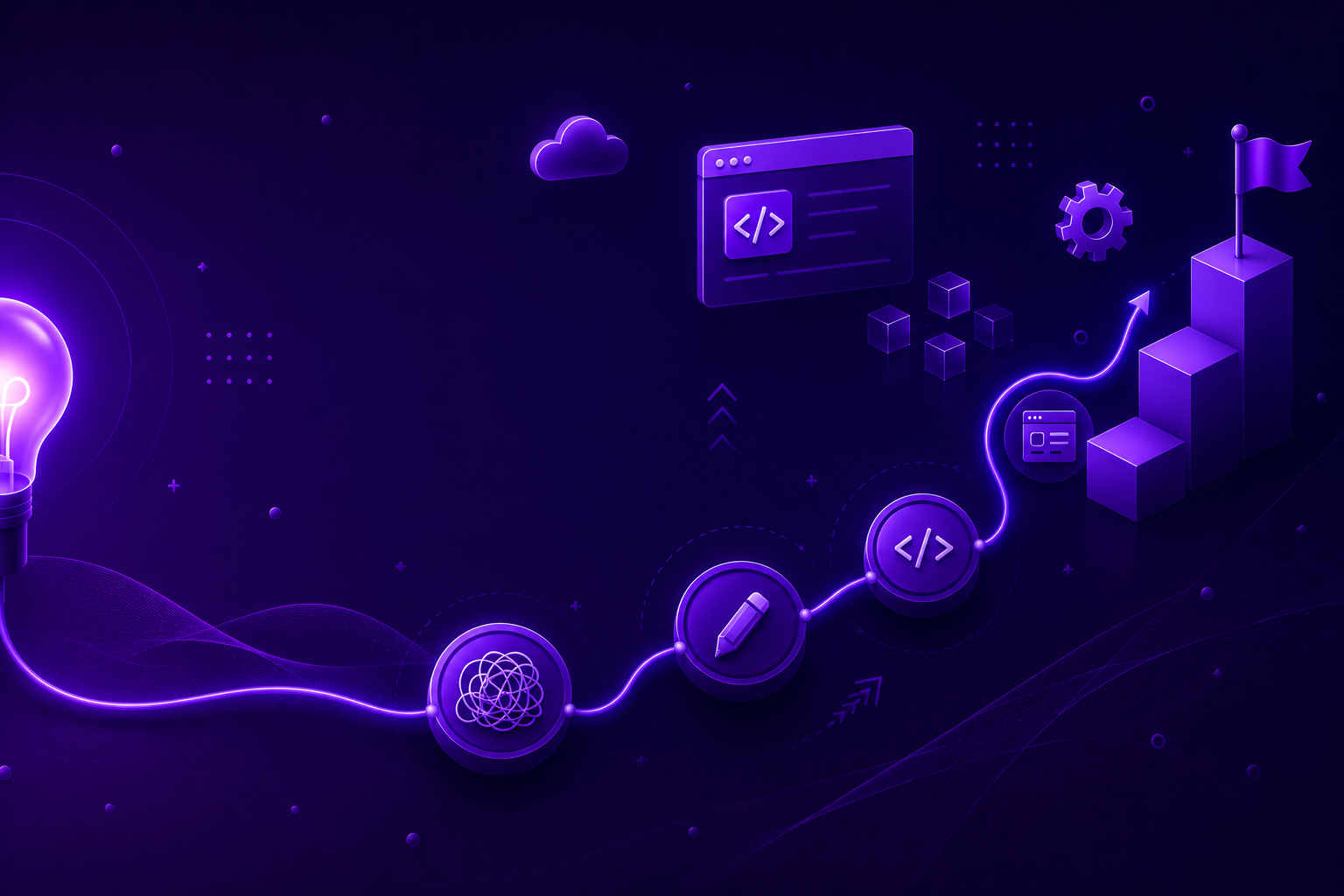
From an idea you can describe to a product people can use.
We define what to build, design it so people understand it, and engineer it so it survives real users. One team from first sketch to production, with you owning every line of it.
Your ideas.
Turned into impactful products.
Product Strategy
We pressure test the idea, cut the scope to what actually proves the thesis, and sequence the rest into a roadmap you can defend to an investor.
UI/UX Design
Interfaces built around how people actually behave rather than how we wish they would, from wireframes through to a design system your engineers can build against.
Frontend Dev
Fast, accessible, responsive frontends on modern stacks, built to stay maintainable after the people who wrote them have moved on.
Backend Dev
APIs, data models, and infrastructure that hold up under real load, with authentication and permissions treated as design problems rather than afterthoughts.
Mobile App Dev
Cross platform or native, engineered for the devices your users actually own rather than the flagship sitting on our desks.
Post-Launch Support
Monitoring, fixes, and iteration against what real usage tells you. The first version is a hypothesis, not a finish line.
Why start with an MVP
- Launch quickly, gather real user behaviour, and change direction before the market does it for you.
- Spend only on the features that prove the thesis, not on the ones that feel reassuring to own.
- Give your team a scoped, goal oriented target instead of a moving definition of done.
- Ship with analytics, monitoring, and support in place from the first day rather than the first outage.
Our approach
Product Strategy & Discovery
We decide what the product must prove, and what the smallest honest version of it looks like.
You leave with
- A written scope, broken down
- A prioritised feature list
- A fixed number against it
UX & UI Craftsmanship
Flows first, then interface. Something clickable before a line of production code exists.
You leave with
- An interactive prototype
- A design system to build against
- Every screen, in a file you own
Full-Stack Development
Weekly demos against working software, never against a status document.
You leave with
- The repository in your name
- Working software every week
- Analytics and monitoring wired in
Deployment & Ongoing Iteration
We ship it, watch it under real traffic, and fix what the first users find.
You leave with
- A deployed, monitored product
- Documentation for the next engineer
- What the first users struggled with


How we engage
Three ways to work with us.
Which one fits depends on how well defined the problem already is and how much of the work you want to keep in house.
Fixed scope build
Best when you know roughly what you need and want a defined outcome for a defined number.
What is included
- Discovery and a written scope
- Design and engineering through to launch
- A named team for the duration
- A warranty period after handover
Fixed price, agreed after scoping. Billed against milestones.
Product partner
Best when the destination is clear but the route is not, and priorities will move as you learn.
What is included
- An ongoing team working to your roadmap
- Continuous design and engineering capacity
- Weekly planning and demos with you in the room
- Direct access to the people doing the work
Monthly retainer. Rolling term, cancellable with notice.
Team augmentation
Best when you already have a team and need specific skills alongside them rather than a separate vendor.
What is included
- Engineers or designers embedded in your team
- Working in your process and your tools
- Scale the number up or down as the work changes
- Handover and documentation as standard
Per person, per month. Minimum engagement agreed upfront.
How we arrive at a number
Every scope is different, so we do not publish rate cards that would be wrong for you anyway. Instead: a 30 minute call at no charge, then a written scope with the work broken down, and a fixed number against it. You see the breakdown before you agree to anything, and nothing starts until you do.
Fit
Whether this is right for you.
A good fit if
- You have an idea or a prototype and need it built properly
- You are non technical and want a team you do not have to manage line by line
- You would rather ship something small and real than plan something large and hypothetical
- You want to own the code, the accounts, and the decisions
- You have a budget in mind and want to know honestly what it buys
Probably not a fit if
- You are looking for the cheapest quote rather than the right scope
- The requirements are fixed, undiscussable, and already written in full
- You need bodies on seats with no say in how the work is done
- You want the work started before anything has been scoped or agreed
- You are hoping to prove an idea without ever putting it in front of a user
Insights
- ArticleBuild Fast, Learn Faster: The Real Purpose of an MVPAn MVP isn’t a smaller product it’s a sharper version of your idea built to learn quickly, reduce risk, and find the shortest path to product market fit. Nov 25, 2025
- ArticleDesigning for Humans: Why UI/UX Determines the Success (or Failure) of Your ProductModern products don’t fail because of bad code they fail because users don’t understand, enjoy, or trust the experience. Here’s how great UI/UX fixes that. Nov 25, 2025
- ArticleFrom Idea to Impact: How Great Digital Products Are Designed, Built & ScaledA deep dive into how raw ideas transform into market ready, user loved digital products through strategic discovery, thoughtful design, robust engineering, and continuous iteration. Nov 25, 2025


Common questions
Answered before you have to ask.
How long does it take?
It depends entirely on scope, which is why we will not quote a number here. What drives it is how much has already been decided, how many integrations are involved, and how quickly you can give feedback. We tell you the honest timeline in writing after the scoping session, before you commit to anything.
What does it cost?
We price after we understand the problem, never before. A 30 minute call at no charge, then a written scope with the work broken down and a fixed number against it. You see the breakdown before you agree, so there is nothing to be surprised by later.
I already built a prototype with an AI tool. Can you take it from there?
Frequently, yes, and it is a good starting point. A prototype answers whether the idea makes sense. What it usually lacks is the last stretch: authentication, permissions, data integrity, error handling, and everything that only matters once real people and real money are involved. We pick it up from wherever it actually is rather than starting again out of habit.
Do I own the code?
Yes, completely, from the first commit rather than the final invoice. The repository, the hosting, the domains, and every credential are in your name throughout. If you decide to take the work elsewhere tomorrow, nothing is held hostage.
Do you work with non technical founders?
Most of our clients are. You will not be asked to make architecture decisions or arbitrate technical arguments. We explain trade offs in terms of cost, time, and risk, and you decide on that basis.
What happens after launch?
Whatever suits you. Some clients keep us on to keep building, some move to a lighter support arrangement, and some hire their own team and we hand over. All three are a fine outcome, and the documentation is written on the assumption that the third one might happen.


