
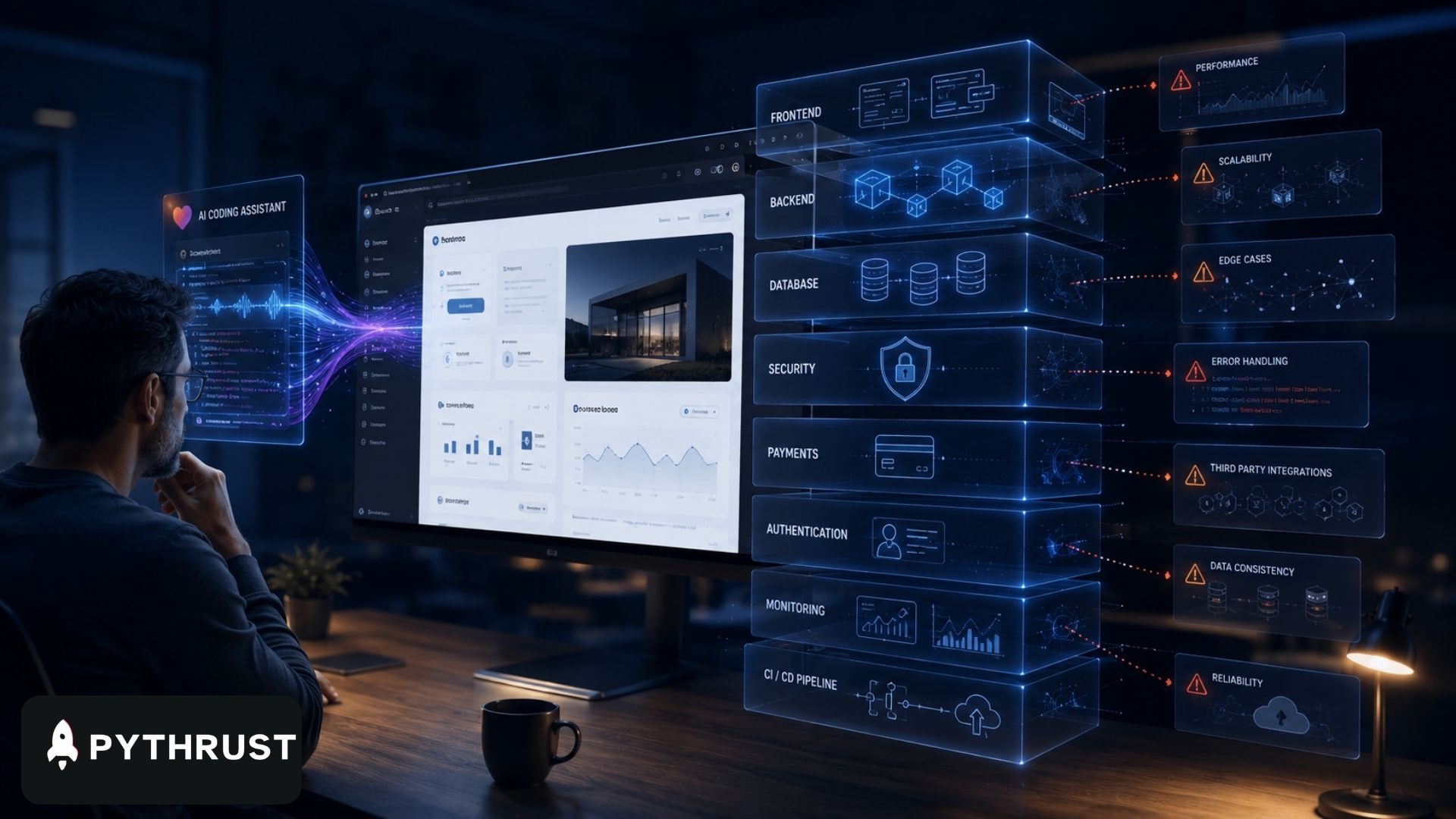

The demo worked. Investors nodded, friends said "impressive," and you felt it - the finish line was close. Six weeks of prompting, iterating, prompting again. No developer, no agency, no equity given away. Just you, an AI builder, and a product that actually moves.
You are not 80% done.
What you've built is real. But what lives in the last 20% isn't polish. It's not a to-do list. It's the part that determines whether your app survives its first real user, its first real load, its first real consequence. Most founders find this out the hard way - usually on the day they try to launch publicly, or the day a user does something the demo never covered.
This article isn't an argument against vibe coding. It's a map of what comes next.
Vibe Coding Earned Its Seat
Let's be honest about what vibe coding actually did. It gave non-technical founders something that didn't exist five years ago: a real seat at the building table.
Before Bolt, Lovable, Cursor, and Angularize, if you had an idea and no technical co-founder, you had two options. Hire an agency and hope for the best, or wait. Neither was good. Agencies were expensive, slow, and rarely invested in your problem. Waiting meant watching someone else ship your idea.
Vibe coding changed the math. Today, 63% of vibe coding users are non-developers - founders, domain experts, operators who spotted a problem and built a solution themselves. They shipped faster, spent less, and kept full ownership of what they made.
That's not nothing. That's a structural shift in who gets to build.
The problem isn't the tool. The problem is what happens when founders confuse "the demo works" with "the product is done." As Rob Fitzpatrick laid out in The Mom Test - founders are wired to seek validation, not truth. A working demo gives you a signal. It doesn't give you a product.
The 80% is real. Own it. But know what you're holding.
What the Last 20% Actually Contains
The last 20% isn't one thing. It's three distinct walls, and most founders hit all three.
Wall 1: Security - the AI shipped defaults, not protection
AI builders are optimised for speed and demos. They're not optimised for production safety. Firebase ships in test mode - fully public, read and write - by default. Most non-technical founders never change this because nothing in the build experience tells them it needs to change.
Quittr, an addiction recovery app, reached $1M in revenue and 350,000 downloads before anyone noticed. The Firebase database had been publicly readable the entire time. 600,000 user records - including data from minors - were exposed (Cybernews, March 2026). The app worked perfectly in demo. It was a liability in production.
It's not an isolated case. A security scan of 5,600 live vibe-coded apps found 2,000+ high-impact vulnerabilities, 400+ exposed secrets, and 175 instances of personal data in the open - all in production systems (Escape.tech via Autonoma, 2026).
Wall 2: Scale and edge cases - the demo hides the real world
Your demo runs on clean data, predictable flows, and a single user who knows exactly what to do. Real users don't behave this way. They click things in the wrong order. They submit empty forms. They arrive from a slow network in a city your demo never tested.
GitClear's analysis of AI-assisted development found 41% higher code churn and 4x more code duplication compared to human-written code. These structural problems don't surface in demos. They compound in production until, around month three, adding one new feature breaks three existing ones.
Google Chrome DevTools engineer Addy Osmani called this the "70% problem" in December 2024: non-engineers reach roughly 70% of a working solution quickly, but the final 30% becomes an exercise in diminishing returns - each fix surfaces new bugs in an accelerating cycle.
Wall 3: Ownership - no one can read or extend this codebase
AI builds each feature in an isolated session, without memory of what came before. The result is duplicated logic, bypassed middleware, and a codebase that nobody - not you, not a developer you bring in next month - can confidently modify.
Alex Turnbull, founder of Groove, spent twelve months building two full-scale AI products via vibe coding and arrived at a clear conclusion: "VibeCoding didn't get us there. Only real engineering could" (TechStartups, December 2025).
This isn't a failure of the tool. It's the natural ceiling of a co-founder who runs out of context.
The Co-founder Handoff
Here's what nobody says out loud: vibe coding was always meant to get you to this wall.
The tools were never designed to replace engineering judgment. They were designed to remove the barrier to entry - to get non-technical founders close enough to a real product that the gap between idea and build becomes manageable. They succeeded. You got to 80%.
Ryan Singer, Head of Strategy at Basecamp, wrote about this in Shape Up: the most dangerous moment in any build is when teams confuse "it's working" with "it's done." Finishing properly isn't just writing more code - it's knowing what done actually means, and having the judgment to close the gap intentionally, not accidentally.
That's what a real team does at the 20% mark. Not what an agency does - agencies scope, invoice, and deliver to spec. A real team audits what exists without burning it down. They finish with intent, not patches. They understand the business context - why this feature matters, who uses it, what breaks if it doesn't work - and they make decisions accordingly.
At Pythrust, we work with founders at exactly this point. We've seen what's inside the wall. We know what can be salvaged, what needs to be rebuilt, and what the founder was right about all along. Our job isn't to redo your work. It's to take the last 20% as seriously as you took the first 80% - and to take that risk with you, not just invoice you for it.
That distinction matters. Not every team that says they can finish your product will actually put skin in the game. Pythrust does.
The Wall Means You're Close
Vibe coding gave you the best head start most founders never had. You moved fast, stayed lean, and built something real - without waiting for a technical co-founder or burning your savings on an agency.
The 20% wall isn't a sign that you did something wrong. It's proof that the idea is real enough to be worth finishing properly.
In 2013, HealthCare.gov launched with $400M behind it. The frontend looked complete. The backend collapsed on day one under real users - not because the interface wasn't ready, but because what sat behind it couldn't hold. Scale, security, and ownership aren't afterthoughts. They're what separate a demo from a product.
If you're at that wall - the demo works, the users are interested, but you know something isn't right -