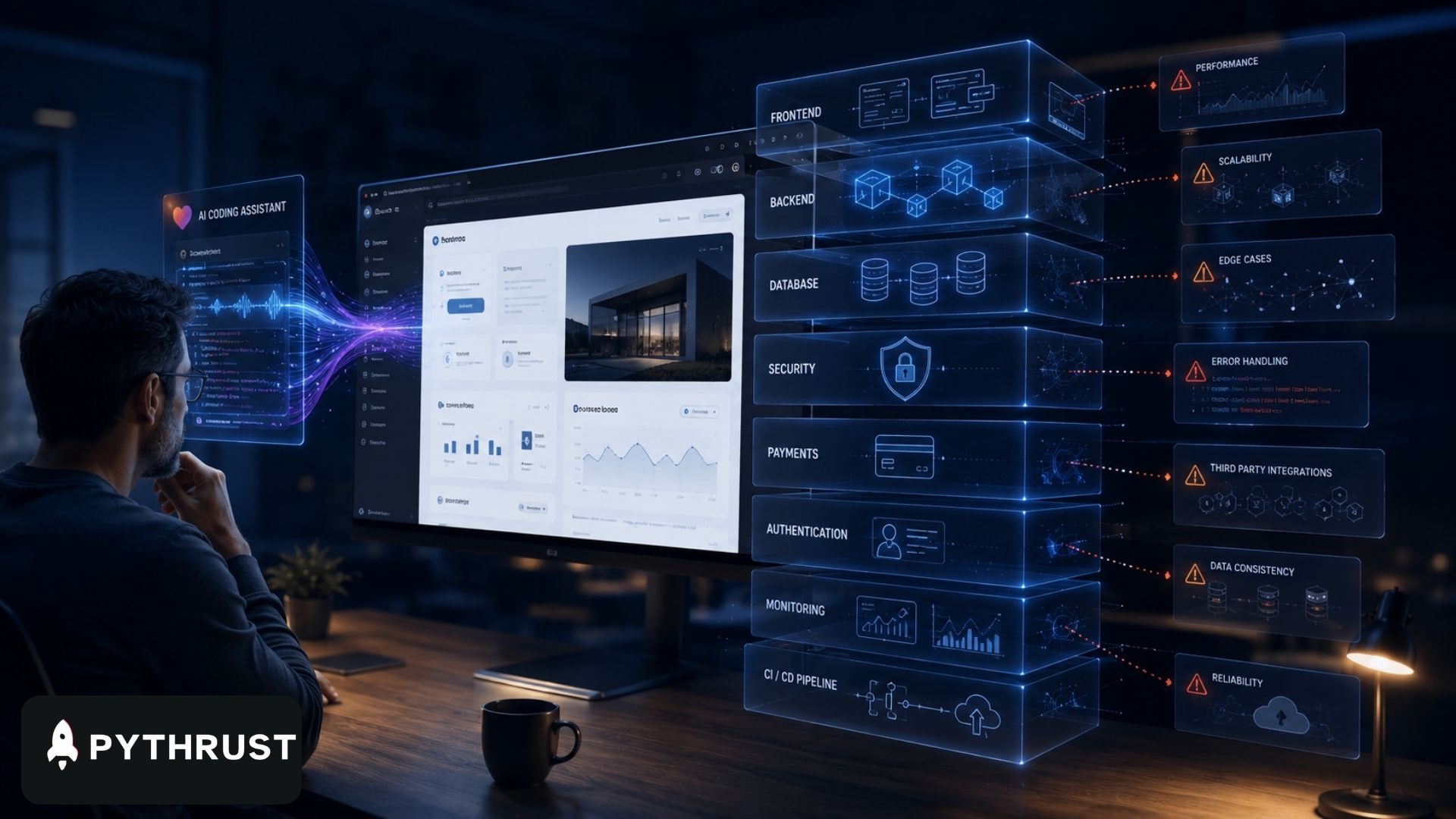


It's 2:47 AM. A founder we work with is awake, again, pasting a ChatGPT answer into our WhatsApp asking, "will this get our app banned?"
He has just spent six months and a few bucks building a real-money skill gaming product. The legal interpretation he is staring at was generated by an LLM. He is not a lawyer. The LLM is not a lawyer. His next message says: "Sir, LLM pe jyada trust bhi sahi nahi h."
We have seen this exact scene 20+ times since February 2024.
Different founder, different industry, different LLM. Same texture. A founder, a screen, a half-built product, and a question no AI tool can actually answer.
The story you have been told is that AI made building easy. That a Lovable weekend or a Cursor afternoon now replaces what used to take a team three months. That an Emergent prompt can produce a shippable product. That Indian vibe-coding platforms are doing $100M ARR in eight months — and yes, that one is true.
But here's what nobody is showing you: across the 20+ MVPs we have shipped, the one thing that decided whether a founder shipped or stalled was not the tools they used.
It was something far less glamorous. And once you see it, you cannot unsee it.
What "shipping in the AI era" actually looks like
Between February 2024 and April 2026, Pythrust shipped over 20 MVPs. The stack was modern: Next.js, FastAPI, Supabase, GCP, Razorpay for payments. The tools were everything you'd expect — Lovable, Cursor, Claude Code, Emergent, Google AI Studio, custom RAG pipelines, agentic flows, eval harnesses. By month two with almost every founder, the conversation turned to agents — sales agents, support agents, ops agents. We now spend half our time building production agents for Indian companies.
The hypothesis we tested, alongside our clients, was the one every founder reading this has heard: AI will collapse MVP timelines from 90 days to 9.
The result?
Building did get roughly 10x faster. A working prototype in three days, not three weeks, is now genuinely possible. We have done it. Many times.
The shipping rate barely moved.
A 2024 Stanford study by Yijia Shao found that 41% of Y Combinator AI startups fail to find product-market fit. A March 2026 enterprise survey reports that while 78% of enterprises have AI agent pilots running, only 14% scale to production — an 88% pilot-to-production failure rate. Sequoia's David Cahn calculates that the AI ecosystem now needs to find $600 billion in annual revenue to justify the infrastructure already built.
Building got faster. Outcomes did not.
This article is about why.
The promise of AI MVPs
Almost every founder who walked into a kickoff call with us in 2025 walked in with the same mental model:
"Lovable in a weekend."
"Emergent will replace my dev team."
"An agent will handle support, sales, ops."
"PRDs are dead. Just prompt."
"Design systems? Tailwind defaults are fine."
It is a coherent worldview. It is also incomplete.
What Lenny Rachitsky and Shreyas Doshi have spent a decade quietly explaining to anyone who would listen is that product work has always been three different kinds of work. Shreyas calls these Leverage, Neutral, and Overhead — the LNO framework.
Leverage (L) — the 10x work. Defining the customer. Choosing what NOT to build. Sitting with a real user for an hour without pitching. Architecting for the failure mode you haven't met yet.
Neutral (N) — the 1:1 work. Writing the PRD. Building the boilerplate. Wiring the auth flow.
Overhead (O) — the <1x work. Status updates. Meeting notes. Repeating yourself in seven Slack channels.
Here is the truth nobody is selling on Instagram reels:
AI made N and O cheaper by 10x. AI did not touch L.
Agents amplify this gap. They do not close it. A founder using Cursor to write boilerplate is using AI on N work — which is correct. A founder using ChatGPT to decide their pricing strategy is outsourcing L work to a stochastic parrot — which is suicide.
The MVPs that died, died because their founders confused the two.
What actually shipped
We sorted the 20+ MVPs into four archetypes. You are likely one of them. We will not pretend you are not.
The Burnt-Once Founder
Ex-corporate. Was scammed by a previous agency. Now flinches every time someone competent asks for money. Personally enters every OTP. Building in a regulated space — usually fintech, real-money gaming, or anything KYC-adjacent.
The 2 AM fear: "Someone vibe-coded my exact MVP over a weekend."
What was actually breaking:
PM failure: No Customer Problem Stack Rank — Shreyas's framework for ranking which problem actually matters most to the user. The roadmap was being written by competitor-watching, not by user-priority.
Design failure: Four onboarding redesigns in six weeks. No design system. Every screen rebuilt from scratch. Infinite rework, zero compounding.
Engineering failure: Razorpay webhook idempotency. Reconciliation logic. RBI-compliant KYC flows. None of this exists in Lovable. None of it exists in Emergent. This is three weeks of integration work AI cannot vibe-code, because the failure mode is not in the code — it is in the bank's systems.
What we did: Froze scope using MoSCoW. Built a real design system in two days. Wrote integration tests around every money flow. Made the founder pay people on time, even when it hurt.
Outcome: Seven months in. Live in production. Not viral. Real.
The Charismatic Founder
Fundraising-fluent. Equity-talker. Pitches an "AI cofounder" angle. Has investors, doesn't have customers. Loved by Twitter, ignored by users.
The 2 AM fear: "OpenAI will build this themselves next month."
What was actually breaking:
PM failure: No North Star metric. Every slide had a different vanity number. Building on hype, not on retention. As Rob Fitzpatrick warns in The Mom Test, the founder was collecting compliments and calling it validation.
Design failure: Design as decoration, not decision. Motion-heavy, accessibility ignored. The brief was "looks like a $10M product."
Engineering failure: Prompt-driven architecture with no eval set. Every model swap was three days of fixing. Token costs were eating runway. The founder had tried three agent frameworks and shipped none. As Arize's field analysis of agent failures shows, an agent with 85% per-step accuracy across a 10-step workflow completes successfully only 20% of the time. This is not a model problem. It is a missing-evals problem.
What we did: Pushed for evals from week one. Built a cost-per-active-user dashboard. Added a caching layer that cut 70% of API spend. Shipped one production agent — scoped tight — that actually worked.
Outcome: Product alive. Team gone. Founder learned the thing nobody could tell him.
The Mission-Driven Founder
Social impact. Grant-funded. The product is fused with their identity. Cannot be told the scope is too big, because the scope is the mission.
The 2 AM fear: "I'll hire wrong, and I won't even know it."
What was actually breaking:
PM failure: No anti-goals (Shreyas's term for what we explicitly will not optimize for this year). Every stakeholder request became a P0. Scope expanded under emotion.
Design failure: Designed for the funder, not the user. First-generation learners couldn't navigate the LMS. The UX was English-first in a Marathi-first audience. The product was technically excellent and functionally unusable.
Engineering failure: Three codebases inherited from previous teams. None documented. WordPress + custom Node + Supabase = chaos. Tech debt was treated as moral debt — too sacred to refactor.
What we did: Hard scope cut using Now/Next/Later. Eight user research interviews with first-generation learners — most of whom had never said "no" to an English form before. Consolidated to one stack. Built a Marathi-first chatbot agent on Google AI Studio that worked because we used Sarvam AI's approach of optimizing for Indic-language tokens, not because we threw a bigger model at the problem.
Outcome: Vision intact. Execution stalled, then restarted. Slow recovery.
The Quiet Operator
Solo. Disciplined. No Twitter. No Demo Day. No "I'm building in public" thread. Pays invoices the same day. Writes things down before every call.
The 2 AM fear: None visible. Possibly none.
What was actually working:
PM clarity: A one-line problem statement on every doc. "Litigation researchers waste four hours a week on document parsing." That sentence was the entire roadmap. She lived inside Clayton Christensen's Jobs to Be Done framework without ever calling it that. Her users had a job. She was hiring herself to do it.
Design clarity: One persona. One core flow. Wireframes before pixels. Three user interviews before three design iterations.
Engineering clarity: Postgres, FastAPI, simple auth. No vector database until she actually needed one. No agents until an eval set existed. Boring stack, well-tested.
What we did: Almost nothing different. She drove. We executed.
Outcome: Shipped on time. Paid on time. Alive. Growing.
The Pattern
Every MVP that shipped had three things. Every MVP that died lacked them.
The shippers shared:
Trait | What it looked like in practice |
|---|---|
A founder who could finish a thought on paper | Real PRDs. Even one-pagers. Not Notion theatre — actual prose. |
A founder who paid people on time | Trust is velocity. Late payments became late code. Every. Single. Time. |
A founder who knew exactly one customer | Could quote a real user from memory. Had the Mom Test running in the background. |
The dead MVPs shared:
Trait | What it looked like in practice |
|---|---|
AI as oracle, not as tool | ChatGPT output pasted as strategy. No human evaluation layer. |
Speed as the goal, not the output | "Two-week MVP" with no kill criteria. No hypothesis. Just velocity. |
Verbal contracts as "trust" | No scope doc. No acceptance criteria. Conflict at every milestone. |
A note on agents — where founders are losing money in 2026
We audit a lot of agent projects now. Most of them are not agents. They are wrappers around a system prompt with an integration or two. Without an eval set, an agent is just an expensive prompt with a confidence problem.
Real agents need: a defined scope, a tool list, a fallback path, a human-in-the-loop boundary, and a regression suite. We have shipped agents that work. We have killed many that did not. The ratio is not improving with bigger models — it is improving with tighter scope.
This is the truth nobody is selling:
AI multiplied building speed. AI did not multiply judgement, taste, or patience.
PM craft matters more now, not less.
The Reframe
For ten years, the bottleneck on building software was can we build it?
In 2026, the bottleneck is should we build it? And underneath that — for whom, with what evals, against what failure mode?
Two reframes worth holding:
The Shreyas reframe: Most execution problems are strategy problems. In 2026, most strategy problems are clarity problems. The founder who cannot finish their own thought on paper cannot brief Cursor, cannot brief us, and cannot brief themselves at 2 AM.
The Lenny reframe: The best founders we worked with built less. They thought more. They paid faster. They wrote things down. The Quiet Operator does not look impressive on Instagram. She is the one still standing in 18 months.
The fear isn't that AI replaces you.
The fear is that AI removes your last excuse.
Building is no longer the hard part. Knowing what to build, for whom, in a regulated and culturally specific market like India — that is the hard part. And that is exactly the part Sarvam AI understood when they built models for Indic languages instead of competing with OpenAI on general intelligence. It is the same lesson Emergent's founders are betting on by embedding their Wingman agent into WhatsApp — because in India, real work happens on chat, not on dashboards.
Specialisation beats generalisation. Clarity beats velocity. Discipline beats vibes.
What this means for you
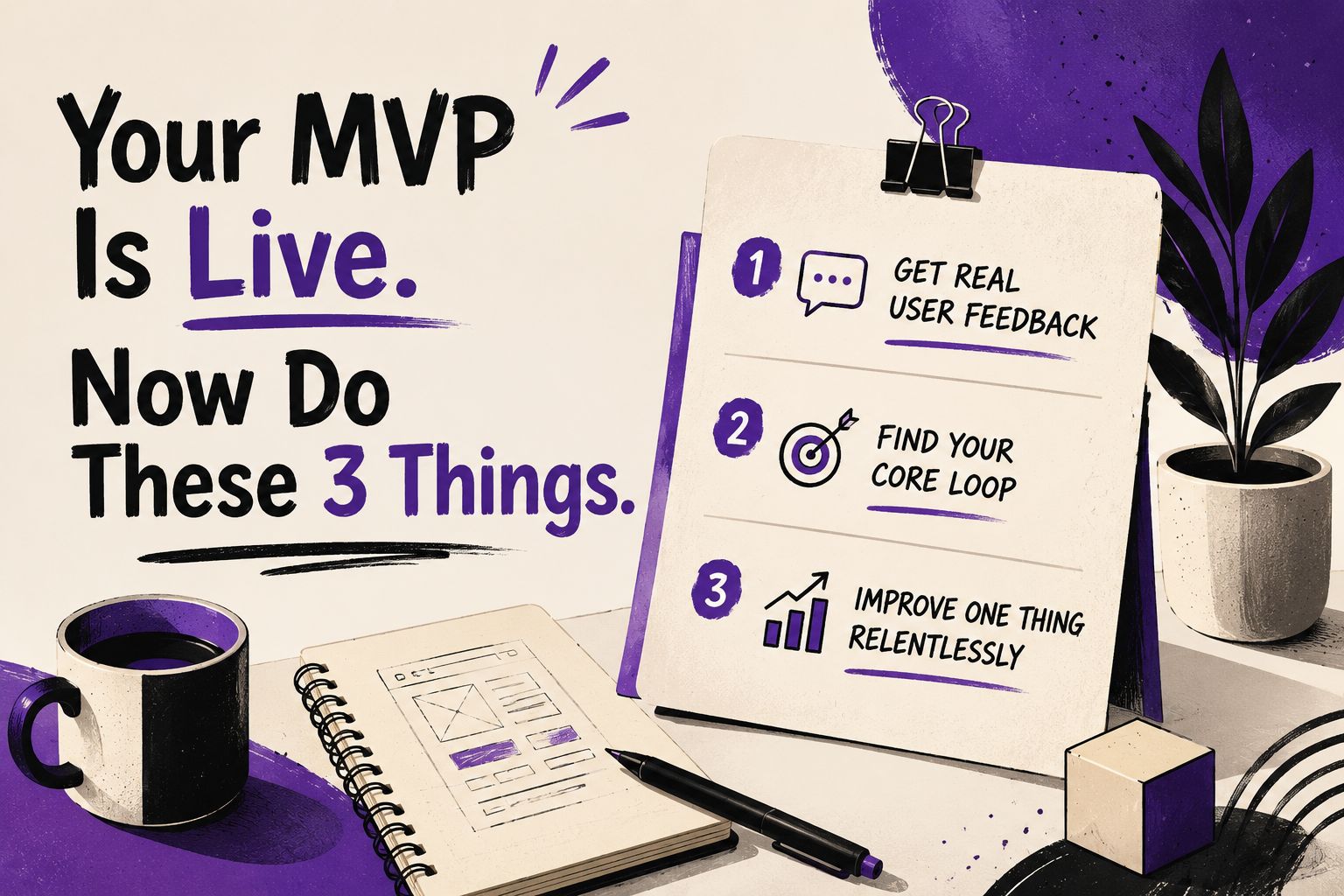
If you read this and recognised yourself in Case 1, 2, or 3 — you are not alone. Most founders we work with start in one of those three. The good news: the move from there to Case 4 is not about better tools. It is about the boring practices nobody tweets about.
Pythrust is not your faster Cursor. We are not your cheaper Emergent. There are venture-backed teams doing that, and doing it well.
What we are is the team that asks the question you have been avoiding. We are your PM, design, and engineering layer for the work AI cannot do for you. We write the PRDs you have been avoiding. We build the integrations AI cannot vibe-code — Razorpay, KYC, RBI, GST, the long tail of Indian compliance. We build the production agents that don't break in week three because we built the eval harness in week one.
We work with founders past the weekend-prototype stage. With founders who have already been burnt once. With founders building in regulated, integrated, real-money spaces. And with companies deploying agents into real workflows.
If that is you — and you would rather be a Case 4 by next quarter than a Case 1 next year — book a 30-minute call.
We will not sell you anything. We will ask you the three questions you have been avoiding asking yourself.
That conversation alone usually saves six weeks.
About Author: Ankit Singh runs Pythrust. We have shipped 20+ MVPs across real-money gaming, EdTech, AR/VR, real-estate analytics, and social-impact platforms since Feb 2024. Half of our 2026 work is production agents.