
Education and EdTech
Content was never the hard part. Getting people to finish is.
Most learning products are full of courses almost nobody completes. We build for the thing that actually matters: completion, real learning outcomes, and the compliance and scale that let a demo become a platform institutions will buy.
The state of play
The market does not lack content. It lacks completion.
Funding has corrected hard and buyers now want proof of learning, not engagement graphs. These are the numbers that decide which products survive that shift.
3–15%
is the typical completion rate for open online courses, a number that has barely moved in a decade. Content is not the bottleneck. Finishing is.
Peer-reviewed MOOC completion studies
~2%
Day 30 retention for education apps, among the lowest of any app category. Most of what you spend acquiring a learner is gone within a month.
Business of Apps benchmarks, 2024–25
~89%
fall in EdTech venture funding from its 2021 peak. The market has shifted from growth stories to proven outcomes and real unit economics.
HolonIQ, via EdWeek Market Brief, 2025
2x
learning in less time, when students used a purpose-built AI tutor rather than a raw chatbot. The engineering around the model is what produced the result.
Harvard RCT, Scientific Reports, 2025
5.9 hrs
saved per week by teachers who use AI weekly, roughly six weeks back over a school year. Workload reduction is where AI pays off first.
Gallup and Walton Family Foundation, 2025
86%
of students already use AI for coursework, most of them weekly. Assessment integrity is no longer optional to design for.
Digital Education Council, 2024
Learning products
built to be finished.
Learning platforms and LMS
Course delivery, cohorts, progress tracking, and certificates, built around completion and mastery rather than around a content library nobody finishes.
AI tutors and copilots
Tutors that teach step by step rather than hand over answers, with the guardrails, retrieval, and evaluation that separate a reliable tutor from a confident guess.
Assessment and integrity
Question banks, auto-grading, and assessment designed for a world where every student has a chatbot, so a score still means something.
Adaptive and personalised paths
Learning that adapts to where each student actually is, which the evidence says is the single biggest lever on outcomes.
Integrations and infrastructure
Video at scale, single sign-on, and the LMS and student-record integrations that decide whether an institution can even adopt you.
Compliance for minors
Data handling built for children from day one, across COPPA, the UK Children’s Code, and India’s DPDP rules, because retrofitting it later is both costly and risky.
The current landscape
Where learning products leak, and where the work is.
Five problems the sector has lived with for a decade, and what building for them properly actually looks like.
The friction
Learners sign up and disappear
Open course completion sits in single digits and education apps lose most learners within a month. Acquisition spend evaporates before anyone learns anything.
What we build
Onboarding, habit mechanics, and cohort structure built into the product, because the evidence is clear that structure and support, not more content, are what drive completion.
The friction
One size fits nobody
A single fixed path bores the ahead and loses the behind. Personalisation is the biggest evidenced lever on outcomes, and most products do not have it.
What we build
Adaptive paths that meet each learner where they are, built on real mastery signals rather than on which video was clicked.
The friction
AI that sounds right and is wrong
A raw chatbot bolted onto a course hallucinates, gives away answers, and can actively harm learning. It demos beautifully and fails quietly.
What we build
Tutors engineered with answer keys, retrieval, and evaluation, and designed to teach Socratically, which is exactly why the studies that worked, worked.
The friction
Assessment nobody can trust
With most students already using AI, an assessment that was valid two years ago may now measure nothing. Institutions will not buy what they cannot trust.
What we build
Assessment redesigned for the AI era: integrity by design, richer question types, and grading that holds up to scrutiny.
The friction
Compliance that blocks the sale
Children’s data rules are tightening at once across the US, UK, and India. A platform that is not compliant cannot be adopted by a school or a serious institution.
What we build
Privacy and safeguarding built in from the first commit, across COPPA, the UK Children’s Code, and India’s DPDP under-18 rules, so compliance is a reason to buy rather than a blocker.
Case study · Learning platform
An LMS built so learners actually reach the end.
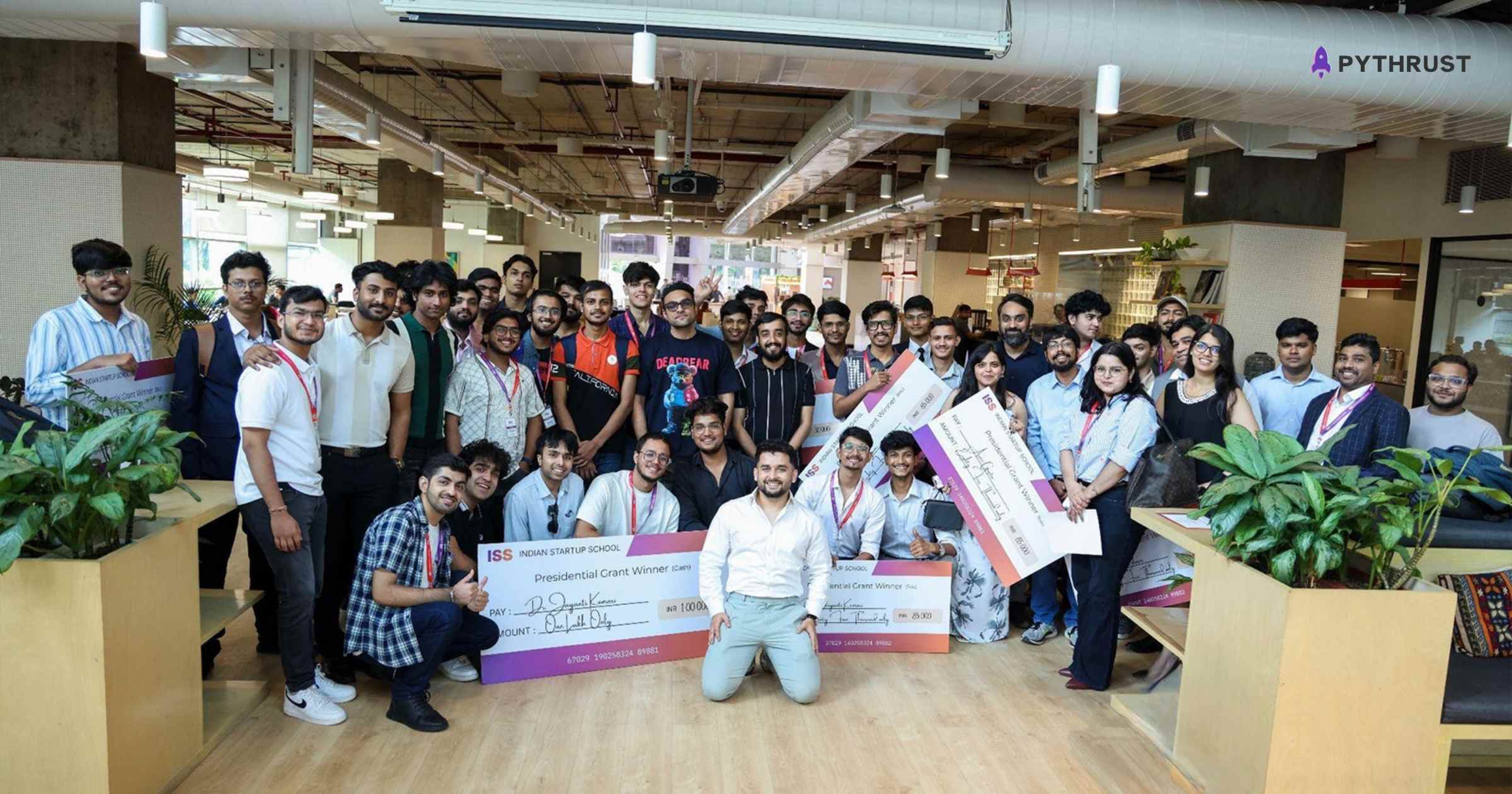
We built Indian Startup School a full learning platform from the ground up: cohort delivery, structured course paths, assessments, and progress tracking that keeps both learners and mentors on the same page. The build was aimed squarely at the metric that matters, completion, rather than at signups.
- 3.1xCourse completion vs their previous tooling
- −60%Manual cohort admin per program
- 6 wksFrom kickoff to first live cohort
How we help you win
Four places a product firm earns its keep.
Not a feature list. The four moves that, on the evidence above, move the numbers that actually decide whether a learning product works.
Make completion the product
The evidence is unanimous that structure and support beat more content. We build the onboarding, cohorts, and habit mechanics that turn signups into finishers, which is the metric buyers now actually check.
Personalise for outcomes
Adaptive, mastery-based learning is the largest proven lever on results. We build the paths and the signals underneath them, so the product improves outcomes rather than just tracking clicks.
Ship AI that can be trusted
A tutor is only useful if it is right and teaches rather than tells. We build the guardrails, retrieval, and evaluation that make an AI feature safe to put in front of a learner or a regulator.
Ship the last thirty percent
Video at scale, integrations, accessibility, and compliance for minors are where EdTech products stall between demo and adoption. That last stretch is precisely what we specialise in.
Fit
Whether this is right for you.
A good fit if
- You have a course, a cohort, or a learning app and need it built to scale
- You are non technical and want a team that owns the hard infrastructure
- You sell, or want to sell, to schools or institutions with real compliance needs
- You care about proving learning outcomes, not only engagement graphs
- You want an AI tutor built with guardrails rather than a chatbot bolted on
Probably not a fit if
- You want the cheapest build rather than one that survives real learners and audits
- The plan is a content library with completion treated as someone else’s problem
- Nobody on your side can define what a good learning outcome looks like
- You need an off-the-shelf course tool rather than a product built around your model
- Data privacy for minors is considered a formality rather than a design constraint
Insights
- Case-studyFrom Ambiguity to a Live ProductIndian Startup School needed a learning platform its first cohort could actually use, fast, with no engineering team of its own. Pythrust built and launched the LMS, wired applications straight into Salesforce, and turned 100+ startup evaluations into the research that shaped the product. Aug 3, 2026
- ArticleThe Rise of Scalable EdTech: Building Learning Platforms That Grow With Your UsersA guide to creating flexible, scalable architectures that support large student bases without compromising performance or experience. Nov 28, 2025
- ArticleWhy Traditional Learning Systems Fail - and How Gamified Journeys Fix the ProblemExplore how rewards, challenges, progress loops, and real-time feedback transform engagement and improve student retention. Nov 28, 2025
- ArticleHow Modern EdTech Platforms Improve Learning Outcomes Through PersonalizationA practical look at how adaptive learning paths and AI-driven recommendations help students learn faster and stay engaged. Nov 28, 2025


Common questions
Answered before you have to ask.
Can you actually improve completion, or just build the platform?
Both, and they are the same job done well. Completion is driven by onboarding, structure, cohort support, and habit mechanics far more than by content, so we build those in deliberately rather than shipping a video library and hoping. We instrument completion from day one so you can see what is working rather than guessing.
We want an AI tutor. How do you stop it being wrong?
By building it the way the studies that actually worked were built: grounded in your own correct material through retrieval, constrained to teach step by step rather than hand over answers, and measured against an evaluation set before it goes near a learner. A raw chatbot on top of a course is exactly the thing that demos well and fails quietly, and we do not ship that.
Do you handle student data privacy and compliance?
Yes, as a design constraint rather than a checkbox. Depending on your market that means COPPA and FERPA in the US, the UK Children’s Code and UK GDPR, or India’s DPDP rules, which treat everyone under eighteen as a child and require verifiable parental consent. We design the data model around those rules from the start, because retrofitting them into a live platform is both expensive and dangerous.
Can you integrate with the LMS and systems schools already use?
Yes. Single sign-on, LTI for LMS integration, and student-record and rostering integrations are usually what decide whether an institution can adopt you at all, so we treat them as core rather than as a later phase. Their absence is what forces a painful migration a year or two in.
Do we own everything at the end?
Completely. The repository, the hosting, the content pipeline, the data, and every credential are in your name throughout. If you take the work elsewhere later, nothing is held hostage.
What does it cost?
We price after we understand the scope, never before, because a cohort platform and an AI tutor are very different builds. A thirty minute call at no charge, then a written scope with the work broken down and a fixed number against it, so there is nothing to be surprised by later.


