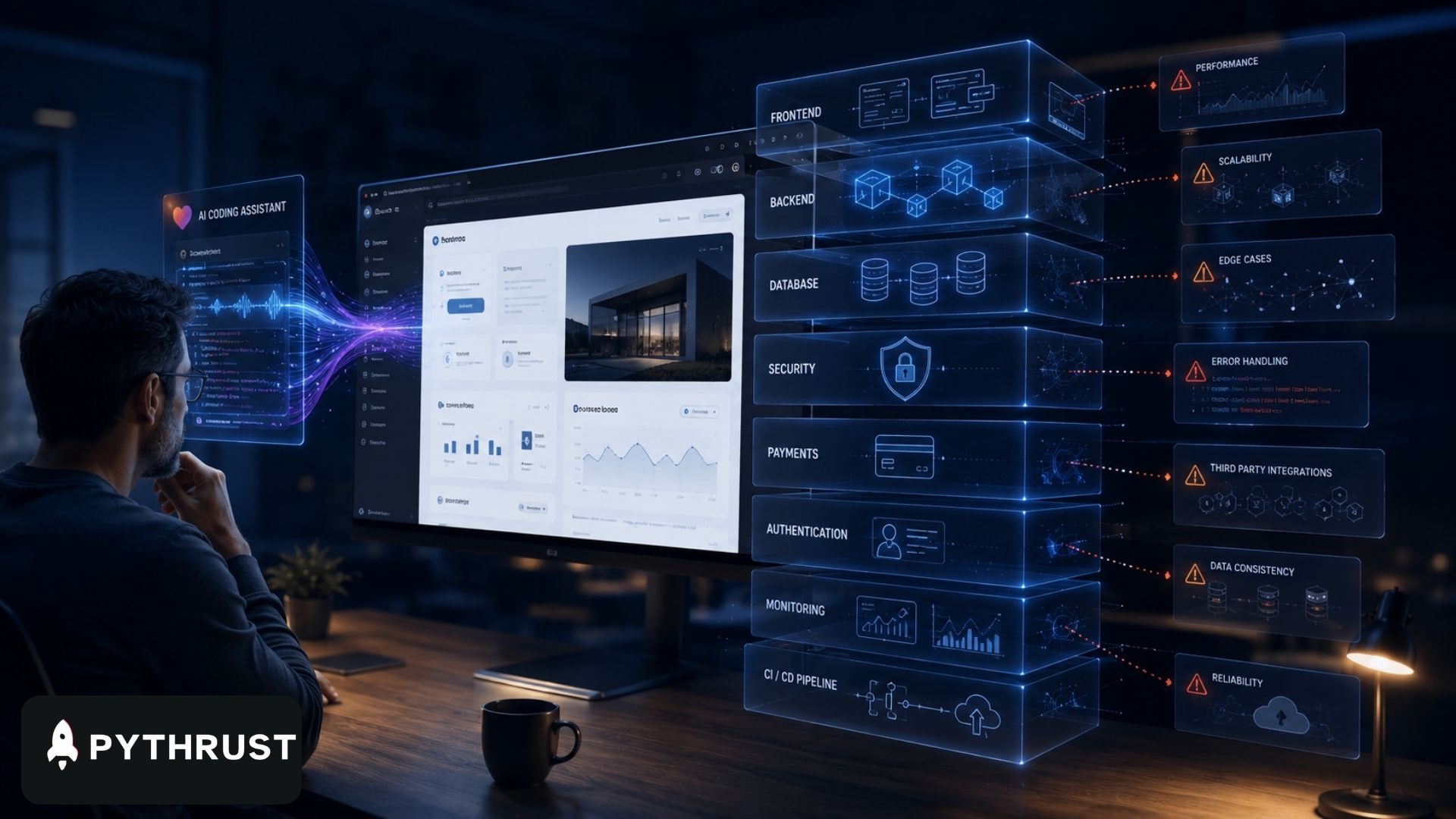
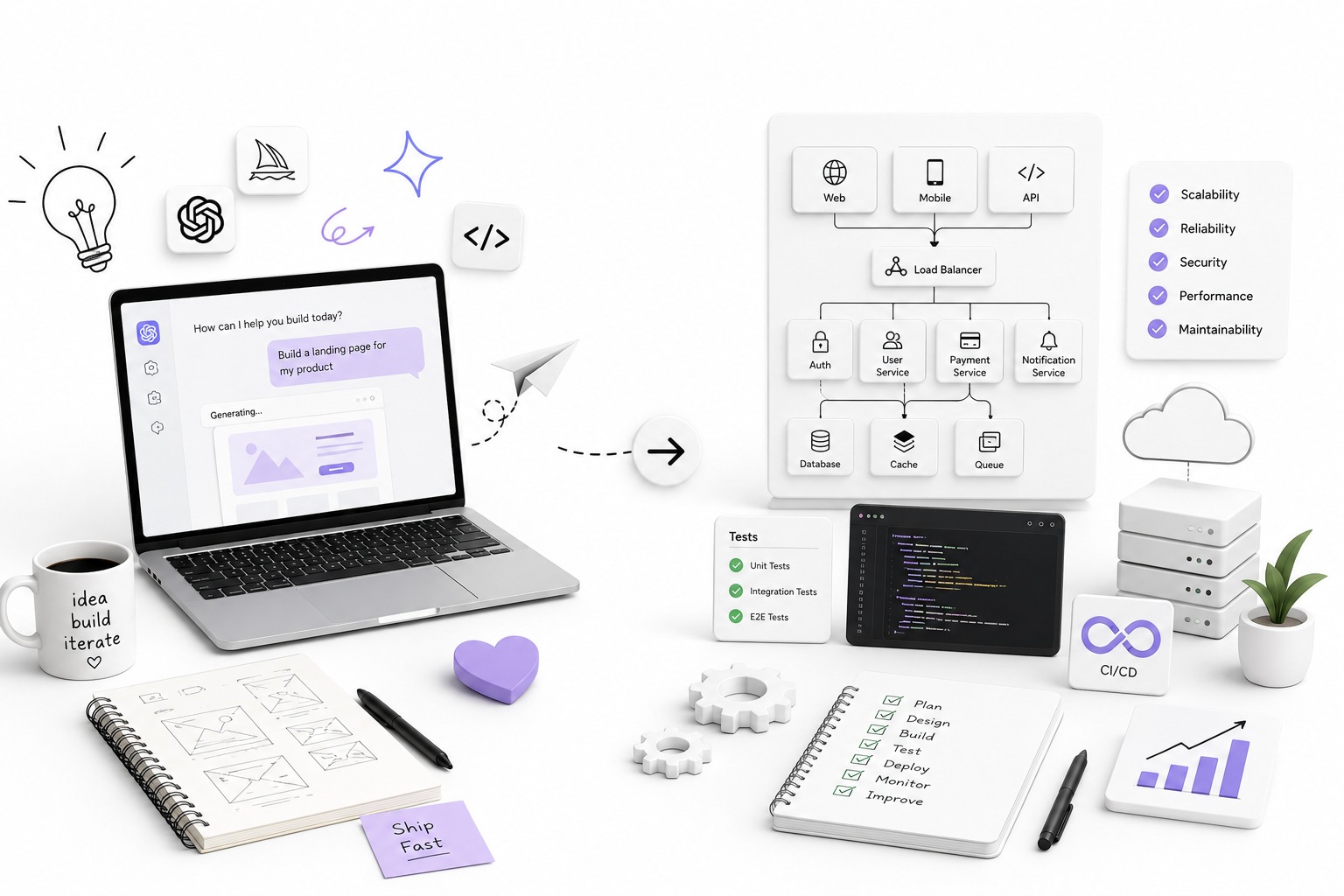

You built something real with AI. It runs. Users are touching it. Now the questions are getting harder — and your AI assistant doesn't know the answers. This is the moment most founders get wrong.
There is a story playing out in thousands of startups right now.
A non-technical founder discovers AI coding tools. In a weekend, they ship an MVP. Users love it. They post about it on X. "I built this with no code," the caption says. It gets 50,000 impressions. Investors DM them.
Three months later, that same founder is on a call with a senior engineer. They are showing him the codebase.
The engineer goes quiet for a while.
Then: "So none of this has authentication middleware. And I'm seeing hardcoded API keys in the frontend. And this database query will time out at 200 concurrent users."
The founder had been vibing. What they needed — and didn't know they needed — was engineering.
Vibe coding is the most powerful idea-validation tool ever invented. It is also the fastest way to build something that will embarrass you at scale.
This article is a checklist. Not to scare you — but to give you an honest map of when AI tools are your best friend and when they are setting a trap you can't see yet.
Part 1: Why Vibing Is Genuinely Revolutionary
Let's be clear about what has actually changed, because the change is real and it is enormous.
Before 2023, a non-technical founder with an idea had two options: give away meaningful equity to attract a technical co-founder, or spend $50,000–$200,000 on a development agency before a single user had touched the product.
The math has changed. Dramatically.
The Numbers That Matter A 2025 survey of 800 first-time founders found that those who built their own MVP using AI tools spent a median of 11 days from idea to first user — compared to 73 days for founders who hired developers. They retained an average of 18 percentage points more equity at first fundraise. |
That is not a marginal improvement. That is a structural shift in what it means to be a founder.
Searches for "vibe coding" jumped 6,700% in spring 2025. Collins Dictionary named it Word of the Year. More than 85% of professional developers now use AI coding tools at least weekly. The majority of those interactions follow the same pattern: describe what you want, get working code back, ship it.
For founders, this era gives you three things it never gave you before:
Speed to validation: test demand before spending real money
Equity preservation: don't hand away 30–50% to attract a technical co-founder
Fundraising signal: investors who see working products offer 20–60% higher pre-seed valuations than those who see slides
This is real. If you haven't used these tools yet, you're leaving leverage on the table. But. There is always a but.
Part 2: The Hidden Cost Nobody Posts About
Here is what doesn't show up in the viral screenshots.
The Security Gap
In March 2026, API security firm Escape.tech scanned over 1,400 vibe-coded production applications. What they found should stop every non-technical founder in their tracks:
🔐 Escape.tech Scan Results — 1,400+ Vibe-Coded Production Apps • 65% had security issues • 58% contained at least one critical vulnerability • 400+ exposed secrets • 175 instances of hardcoded credentials • Every application tested lacked CSRF protection • Every tool introduced Server-Side Request Forgery vulnerabilities |
These aren't exotic exploits. CSRF, SQL injection, exposed API keys — these are the OWASP Top 10. The vulnerabilities that any competent security review catches in a weekend. The ones that, when they appear in a live product with real users, become a lawsuit, an outage, or a breach notification email.
Veracode tested over 100 large language models on security-sensitive coding tasks across Java, Python, C#, and JavaScript. Result: 45% of AI-generated code samples introduce OWASP Top 10 vulnerabilities — a pass rate that has not improved across multiple testing cycles from 2025 through early 2026 despite vendor claims.
The AI is optimised for code that runs and appears correct. Not for code that is resilient under adversarial conditions. That distinction will cost you — the only question is when.
The Technical Debt Clock
GitClear analysed 211 million lines of code written between 2020 and 2024. They found an 8x increase in duplicated code blocks from AI tools.
Duplication is the first symptom of a codebase that will become unmaintainable. It means the AI didn't build architecture — it built copies. When you try to change one thing, you have to change it in eight places, and you won't know where all eight are until one of them breaks in production at 2am.
Carnegie Mellon studied 800+ GitHub repositories. The pattern was consistent: vibe-coded codebases accumulate debt at rates that make them difficult to onboard into — meaning your first engineering hire will spend weeks just understanding what was built before they can improve anything.
💸 The March 2025 Incident A vibe-coded payment gateway approved $2M in fraudulent transactions due to inadequate input validation. The AI had copied insecure patterns from its training data — creating a vulnerability that a human developer would have caught in code review. That's not an isolated incident. It's a preview. |
The Production Gap
Deloitte's State of AI 2026 report found that only 25% of organisations have moved 40% or more of their AI pilots into production. The rest are stuck.
Separately, MIT found that 95% of generative AI pilots fail to produce measurable revenue or cost savings. The issue isn't that the demos don't work. The issue is that moving from "this works in my local environment" to "this runs reliably for 10,000 users" requires an entirely different set of skills than the ones that built the demo.
Security hardening. Environment parity. Load testing. Graceful degradation. Rollback procedures. Database migration strategies. Rate limiting. Monitoring and alerting. Incident response.
None of this is in the Lovable tutorial. All of it is in production.
Part 3: The Checklist — 10 Signals It's Time to Stop Vibing
This is the core of what this article exists to give you. Not a vague "you'll know when you know" — a concrete list of signals that tell you the vibe phase is over.
Read each one carefully. If three or more apply to you right now, you are past the point where AI tools can safely carry the load alone.
Signal 1 — Real users are touching it
You have moved past testing with friends. People who are not you, not your team, and not your investors are using this product — paying or not.
When real users arrive, the attack surface expands. Real users do unexpected things. They send unexpected inputs. Some of them are actively trying to break it. Your vibe-coded authentication logic that "works fine in testing" has not been tested by someone with malicious intent.
The moment real users arrive, security stops being an abstract concern.
Signal 2 — You are handling money
Any transaction, subscription, invoice, or financial data flows through your system.
Payment security is one of the most specialised areas in software engineering. PCI DSS compliance, tokenization, idempotency keys, webhook verification, fraud prevention logic — these are not things you want to vibe your way through. The March 2025 $2M fraud incident wasn't a freak event. It was predictable.
If money moves through your product, engineering is not optional.
Signal 3 — You are storing personal data
User emails, names, addresses, health information, behavioural data — anything that falls under GDPR, CCPA, HIPAA, or equivalent regulation.
Data protection compliance is a legal obligation, not a best practice. The regulatory fines for a breach don't care how you built the system. GDPR can fine you up to 4% of global annual turnover. "I used an AI tool" is not a defence.
Signal 4 — The AI tool says it doesn't know
You've started getting responses like "I'm not sure this is the right approach" or "you should consult a professional for this" from your AI tool.
This is underrated as a signal. AI tools are remarkably good at tasks they were trained to do. When they start hedging, it's because you've hit the edge of the well-lit territory. You're in the architectural wilderness. That is exactly where an engineer's judgment — built from years of building systems that failed in predictable ways — is irreplaceable.
Signal 5 — You can't explain what your codebase does
A new team member joins, or an investor asks a technical question, and you genuinely don't know the answer — not because you haven't had time, but because you've never understood it.
Vibe coding generates code. It doesn't necessarily generate understanding. If the person most responsible for your product cannot explain how the critical paths work, the system is more fragile than it looks. You cannot make good decisions about something you don't understand.
This isn't about becoming a developer. It's about having an engineer who can explain it to you — and making sure they do.
Signal 6 — You need to integrate with enterprise systems
A potential client or partner requires SSO, SOC 2, API rate limiting, audit logs, or custom data contracts.
Enterprise sales lives or dies on security and compliance documentation. When a Fortune 500 procurement team asks for your trust report, your penetration test results, and your data processing agreement, the answer cannot be "we used Cursor." An engineer who understands enterprise integration patterns — authentication flows, event-driven architectures, SLA definitions — is the difference between closing and losing.
Signal 7 — You are approaching 1,000 users
You're experiencing real growth and starting to think about what happens if this actually works.
Most vibe-coded architectures were not designed for scale — because they weren't designed at all, in the intentional sense. Naive database queries that work at 100 users hit timeouts at 1,000. Unindexed tables that feel fast in testing become the source of outages at scale. Monolithic architectures that made iteration easy become the bottleneck that slows everything down.
The engineering work required to survive 10x growth is not the same as the engineering work that got you to 1x.
Signal 8 — A bug costs you money or reputation
You've had an incident that resulted in data loss, user-facing downtime, or a public complaint that spread.
This is the feedback loop you don't want to learn from. When an incident happens, the question is always: "Could this have been prevented with proper engineering?" Almost always, the honest answer is yes. Monitoring and alerting. Graceful error handling. Database backups. Rollback procedures. These are engineering disciplines, not AI tool features.
Signal 9 — You are raising a Series A or later
Institutional investors are conducting technical due diligence on your codebase.
Early-stage investors tolerate a lot. Series A investors send engineers to review your code. A codebase that can't survive that review will stall your raise — not because investors don't believe in AI tools, but because they've seen enough AI-generated codebases collapse under their own weight that they know the signs.
Founders who built their own MVP using AI tools raised at 20–60% higher pre-seed valuations. But those valuations require the product to hold up under scrutiny.
Signal 10 — The team is growing beyond two people
👥 You need more than one person working on the code simultaneously.
Vibe-coded codebases typically lack the structure that makes multi-person development tractable. No clear module boundaries. No documented APIs between components. No testing suite to catch regressions. When two people make changes simultaneously in an unstructured codebase, merging those changes becomes a crisis. Engineering isn't just about writing code — it's about building systems that multiple people can work in without breaking each other's work.
Part 4: What the Transition Actually Looks Like
Knowing you need engineering help is one thing. Knowing what to do with that knowledge is another.
Don't throw away what you built
Your vibe-coded MVP has proven something invaluable: the idea is real. Users exist. Demand is validated. That is not nothing — that is the hardest part of building a startup.
"Don't hand over a codebase generated by three different AI tools and pretend it's been engineered. Ask engineers to assess risk levels: security, performance, maintainability. Accept their judgment on what needs to be rewritten." — Martin Sandhu, Product & Tech Strategist
A good first engineering hire does not tear down what you built. They audit it. They identify what's safe to keep, what needs hardening, and what needs rebuilding. They make the call based on evidence, not ego.
What to look for in your first technical hire
This is not a LeetCode situation. You are not hiring someone to solve algorithm puzzles — you are hiring someone to be accountable for a live system. The interview questions that matter are different:
"Tell me about a production incident you caused and what you did about it." — someone who has never broken production has never shipped anything real
"A non-technical founder asks you to build something you think is the wrong call. How do you handle it?" — you need someone who pushes back constructively, not just executes
"You've inherited a codebase with no documentation. What does your first week look like?" — this is your situation, exactly
"How do you design something that needs to handle 100 users today and 100,000 in 18 months?" — architectural judgment under uncertainty is the skill you actually need
In 2026, 42% of new engineering hires start as contractors before converting to full-time — meaning you don't have to commit before you see how they work. The contract-to-hire model was built for exactly this situation.
If you're not ready to hire: use a fractional CTO
A fractional CTO is a senior technical leader who works part-time with your company. They do the architectural review, identify the critical vulnerabilities, design the migration path, and give you a clear brief on what to build — and in what order — before you make your first full-time engineering hire.
If you can't yet justify a senior full-time hire, this is the bridge. A fractional CTO costs a fraction of a full-time hire and saves you from the expensive mistake of hiring the wrong engineer at the wrong moment.
Part 5: The Real Competitive Advantage
Here's what nobody in the vibe coding conversation says plainly enough.
The advantage of the AI era for non-technical founders isn't cheaper code. It's compressed learning. You now understand — viscerally, from building — what your product needs to do. You have a working prototype that shows investors real traction. You have user feedback that would have taken months and $100,000 to acquire before 2023.
The vibe phase buys you signal. Engineering converts that signal into a business.
The founders who win in this era are not the ones who vibe the longest. They are the ones who know when to switch modes.
Rapid creation is getting commoditized. Professional engineering judgment is becoming more valuable, not less.
The founders who understand both — who used AI to get to traction fast, then brought in real engineering discipline to make it defensible — are building the companies that will matter in five years.
The Vibe-to-Engineering Timeline Months 0–3: Vibe. Ship fast. Validate demand. Retain equity. Raise on traction. Month 3–12: Engineering review. Identify risks. Harden what's live. Plan architecture. Month 12+: Scale with intentional architecture. The vibe phase advantage has a shelf life of 12–18 months. After that, the same tools that got you here become the ceiling. |
What This Means If You're Building Right Now
If three or more signals from Part 3 apply to you, your vibe phase is over — or it needs to end very soon.
That is not a failure. It is the best problem a startup founder can have. It means something you built is real enough, alive enough, and used enough that it deserves to be engineered properly.
At Pythrust, we built Angularize — a production AI product, shipped to 100+ users, with multi-agent architecture, deployment infrastructure, and the failure modes to prove it was real. We didn't theorise about what production AI systems need. We broke them, rebuilt them, and shipped them again.
We bring that experience to every founder we work with. Not a theory of how to transition from vibe to engineering — an actual path, based on what we learned doing it ourselves.
Whether you need an architectural review of what you've built, a production hardening plan, or a team to build the next version from a proper foundation — we can help.
Ready to engineer what you've built? Book a call with Pythrust →
© 2026 Pythrust Technologies. All rights reserved.