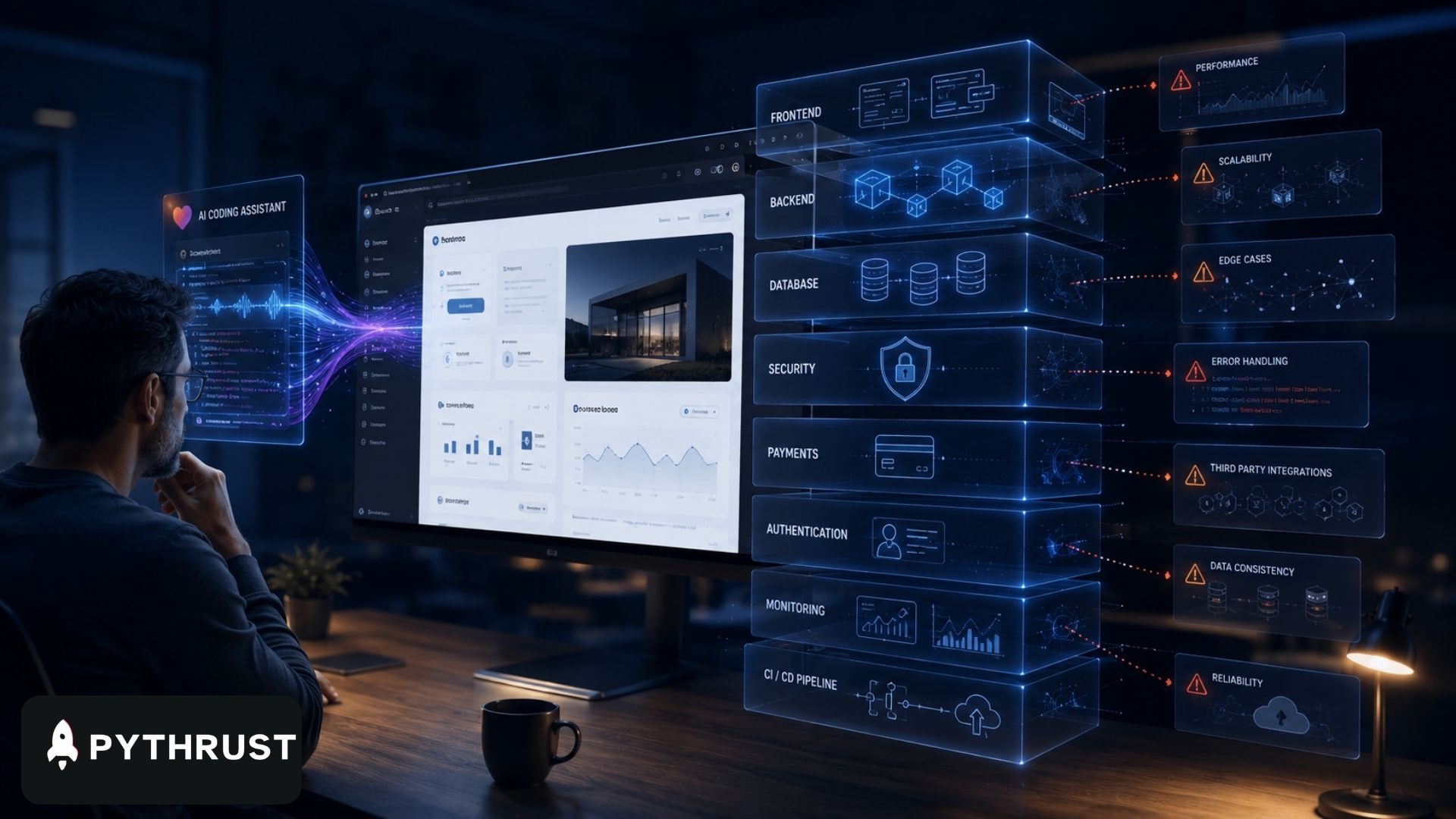

There is a story we have been told about software for a long time. It goes something like this: building a real product - not a demo, not a prototype someone shows at a hackathon, but something genuinely live, used by real people, running on real infrastructure - requires resources most people do not have.
It requires a funded team. It requires engineers with years of experience who have shipped before and know what they are doing. It requires months of runway, a product manager to keep things from going sideways, a designer who understands how real users think, and a DevOps engineer who knows what production actually looks like. It requires, in other words, a kind of structural advantage that most people - most founders, most small teams, most ambitious individuals sitting somewhere in the world with a good idea and no institutional backing - simply do not have.
If you did not have all of that, the unspoken message was clear: your idea was not ready yet. Come back when you have raised your seed round. Come back when you have the right team. Come back when you are serious.
We believed that story too. For longer than we should have.
Then something shifted. Not a single moment, but a gradual accumulation of evidence that the old rules no longer applied in the way they once did. Tools that used to require a senior engineer to configure could now be set up in hours. Infrastructure that once cost tens of thousands of dollars a month had become affordable. AI models that could generate, validate, and iterate on code had moved from research curiosity to everyday tool. The inputs required to build software were changing faster than the conventional wisdom about who got to build it.
Fewer than 1% of people globally possess the skills to develop software independently. The rest of the world's ideas stay locked inside people's heads. That statistic used to be a hard constraint. We think it is now the single biggest opportunity in technology.
The proof was everywhere, for those paying attention. Lovable - an AI-powered app builder - went from a single open-source GitHub repository to $200M in annual recurring revenue in under twelve months. A non-technical growth marketer named Sabrine Matos built Plinq using Lovable, reached 10,000 users and $456,000 ARR, and said publicly: 'If Lovable didn't exist, Plinq would never have seen the light of day.' WordPress was built in 2003 by Matt Mullenweg, a 19-year-old college student with no venture funding, no co-founder with a CS degree, no enterprise backing - and it now powers 43% of every website on the internet.
These are not outliers. They are early data points in a pattern that is now unmistakable. The barrier to building software is collapsing. The democratisation of the tools that create software - which is itself the tool by which every other industry now operates - is one of the most significant shifts of this decade.
And we wanted to be on the right side of it. Not as observers. Not as consultants writing reports about what was changing. As builders.
So we built Angularize.
The World We Were Building Into
Before we explain what Angularize is and how we built it, it is worth spending a moment on the context in which we made the decision to build it. Because the decision did not happen in a vacuum, and the context shapes what we learned.
In 2024 and into 2025, the conversation about AI in software development had reached a kind of fever pitch. Every agency was claiming AI expertise. Every product deck had a slide about 'AI-powered' features. Every conference talk began with the assumption that AI was the future and proceeded to explain, often vaguely, how the speaker's company was already living there.
The noise was significant. And underneath the noise was a real and growing frustration among the founders and business owners we spoke to: nobody could tell the difference between genuine AI capability and a wrapper around an API call. The language had been stretched so thin that it had lost meaning.
AI-washing - the practice of labelling conventional software as AI-powered without meaningful AI capability underneath - became the number one buyer complaint among technology decision-makers in 2025. Proof, not positioning, was what serious buyers wanted.
We felt this frustration ourselves. Not because we were on the buyer's side, but because we were building client AI solutions and we kept encountering the same ceiling: the gap between what we could promise a client and what we could actually deliver was narrower than we wanted. Not because our engineers were not talented - they were. But because there is a difference between understanding how to use AI tools and understanding how AI systems behave under the pressure of real-world usage.
The only way to close that gap was to build something ourselves. Something we were fully accountable for. Something that would break in front of real users and force us to fix it in real time. Something that would teach us, through direct experience, what production AI actually feels like from the inside.
That is where the idea for Angularize began. Not with a market opportunity analysis or a business case document. With a problem we kept running into, and a conviction that the best way to solve it was to build our way through it.
Why Angular specifically
Angular is one of the most powerful front-end frameworks in existence. Google built it and maintains it. Enterprise teams - the kind that build the software powering banks, hospitals, logistics companies, and government services - choose Angular because of its structure, its scalability, and its opinionated architecture that makes large codebases manageable.
But Angular has a reputation problem. It is widely seen as difficult to learn, especially compared to newer alternatives like Next.js or React with Vite. The setup is verbose. The concepts - decorators, dependency injection, Ng Modules - are unfamiliar to developers coming from simpler frameworks. The documentation, while comprehensive, assumes a level of prior knowledge that creates a steep on-ramp for anyone new.
The result was a paradox: one of the most powerful tools in the ecosystem was being systematically avoided by precisely the developers who were building the next generation of products, because the cost of getting started felt too high relative to the alternatives.
We saw the gap. We had the team close it. And with the AI tooling now available to us, we believed we could build something that made the on-ramp to Angular not just shorter, but nearly instant - without sacrificing any of the structural advantages that made Angular worth choosing in the first place.
What if you could describe what you wanted to build in plain language, and get a production-ready Angular application back - without writing a line of boilerplate?
That was the question Angularize was built to answer.
Why We Built Angularize - The Full Story
The decision to build Angularize was not a single moment of clarity. It was a series of smaller decisions that accumulated into a commitment.
It started with conversations. Our engineers kept running into the same friction when onboarding clients onto Angular-based projects. The setup time was significant. The configuration decisions - which state management library, which routing structure, which testing framework - consumed hours that should have been spent building features. Junior developers on client teams struggled to understand the codebase structure well enough to contribute effectively. Senior developers spent too much time on scaffolding and not enough time on the problems that actually required their expertise.
We started keeping a list of the questions that came up repeatedly. Then we noticed something: most of them had answers. Clear, defensible, best-practice answers that an experienced Angular developer would give without hesitation. The knowledge existed. It just was not encoded anywhere in a form that made it immediately useful to someone who did not already have it.
The second set of conversations was with founders - specifically, non-technical founders who had been told that Angular was what their enterprise clients expected, but who had no engineering background and no way to evaluate whether the team they were hiring actually knew what they were doing. They were making multi-hundred-thousand-rupee decisions based on presentations they could not independently assess.
The combination of those two problems pointed at a single solution: a tool that encoded Angular expertise so deeply that both the experienced developer who wanted to move faster and the non-technical founder who wanted to build at all could get real value from it.
The decision to build it for ourselves first
This is the part of the story that matters most, and the part that is most often skipped in company origin narratives.
We did not build Angularize as a client project. We did not build it as an internal tool that happened to grow into a product. We made a deliberate, explicit decision to build it as our own product, with our own money, on our own time, accountable only to ourselves and the users who signed up for early access.
That decision was not comfortable. It meant our team was spending hours on something that was not generating revenue in the short term. It meant our engineers were working on two things at once - client work during the day and Angularize in the spaces around it. It meant we were betting that the investment would pay off not just as a standalone product but as a learning experience that would make everything else we did better.
The bet was informed by something Sam Altman said at YC AI Startup School in June 2025: "Our AI models are ahead of the products we've built with them - that gap is a massive opportunity for startups." We believed that. We had seen it in our own work. The tools available to us were more capable than anything we had yet built with them. Angularize was our answer to that gap.
We also took seriously what Paul Graham has written about small teams and original work: "Great work tends to grow out of ideas others have overlooked. Don't be discouraged if what you produce initially is something others dismiss as a toy." Angularize started as exactly that kind of thing - an internal build that the market had not asked for yet. We built it anyway.
The team that shipped it
Seven people. That is the entire team that built, tested, broke, rebuilt, and shipped Angularize. No external funding. No enterprise client budget. No VC backing. Just a focused group of people with complementary skills and a shared conviction that the thing they were building was worth building.
Ankit - product vision, architecture decisions, and the strategic spine of what Angularize was trying to be
Mahbob - AI systems engineering, LLM integration, and the multi-agent orchestration layer that made the product work
Madhan - backend infrastructure, API design, and the systems that kept everything running under load
Aditi Sharma - UI/UX design, making the interface feel simple for non-technical users despite the complexity underneath
Anjali Negi - frontend engineering, building the user-facing layer that translated AI outputs into something real and usable
Ashwin Bhatt - frontend engineering, contributing to the component architecture and the interaction model
Mansi Chawla - DevOps and deployment, owning the infrastructure that took code from a local environment to a live, running application
What made this team effective was not just the skill distribution. It was the ownership model. Every person on this team owned their domain completely. Mahbob did not have to wait for a committee decision about AI architecture. Mansi did not have to escalate a deployment question to someone above her. Ownership was the accelerant. When something broke - and things broke constantly in the early weeks - the person accountable for it fixed it, learned from it, and made the system stronger.
Over one hundred early users tested the product before we called it ready. They found edges we did not know existed. They used the product in ways we had not anticipated. They told us, with the bluntness of people who had nothing to lose by being honest, where it fell short of what they needed. That feedback loop - direct, unfiltered, and continuous - was as important as anything our engineers built.
What Building Angularize Actually Taught Us
We are going to be honest here in a way that company origin stories often are not.
Building Angularize was harder than we expected. Not in the ways we expected it to be hard - not the technical complexity of Angular, not the challenge of working with LLMs, not the product design questions about how to make AI outputs feel natural. It was hard in ways that only revealed themselves after we were already committed. In ways that no amount of planning would have surfaced. In ways that required us to encounter real failure before we could understand what real success would look like.
These are the lessons. All of them were earned.
Lesson 1: The hard part was never the AI model
Every founder and every team building an AI product for the first time makes the same mistake. They spend the bulk of their planning energy on the model: which LLM to use, how to write the prompts, how to fine-tune the responses, how to get the AI to produce output that is good enough. The assumption is that if you get the model right, the product will follow.
The model is the easy part. Or rather - it is the part that, once you have chosen a capable LLM and written clear prompts, largely takes care of itself. The model does what you ask. The challenge is everything you have to build around it to make the model useful in a real product context.
The hard part is context.
In Angularize, a user describes what they want to build. The system has to take that description, understand it well enough to generate accurate Angular code, and then - critically - maintain the right context across every subsequent interaction. If the user says 'add a login component,' the system needs to understand the existing architecture of the application they have been building, the naming conventions already in use, the state management pattern already established, and the Angular version already committed to. Without that context, the output is plausible but wrong.
We rewrote our context management layer three times before we got it right. The first version passed too little context and produced incoherent output for anything beyond simple single-component requests. The second version passed too much context and hit token limits that made the system slow and expensive. The third version - which required us to build a selective context compression system - finally produced the results we needed.
Anthropic's own engineering team wrote something that we read partway through building and immediately printed out and put on the wall: "When building AI agents, the last mile often becomes most of the journey." In our experience, the last mile was not 20% of the work. It was closer to 60%.
This matters for everyone building AI products - not just us. The instinct to evaluate an AI product by the quality of its demo is understandable but misleading. A demo is controlled. It uses prepared inputs. It avoids the edges. The real question is not whether the model produces good output when asked a clean question. The real question is whether the product maintains its integrity when real users use it in unexpected ways - and the answer to that question requires everything around the model to be right.
Evaluating an AI product by its demo is like evaluating a restaurant by how it looks in photos. The photo is real. But it tells you nothing about what happens when the kitchen gets busy on a Saturday night.
Lesson 2: Multi-agent systems fail in ways that demos never show
Angularize is not a single AI call. That is the version that exists in pitches and one-pagers, and it is technically inaccurate. The real architecture is a multi-agent system a set of specialised AI agents, each responsible for a specific part of the application generation process, coordinating with each other to produce a coherent output.
One agent handles intent parsing - understanding what the user is actually asking for. Another handles code generation. Another handles validation - checking that the generated code is syntactically correct and architecturally consistent. Another handles deployment scaffolding - generating the configuration files and environment setup required to run the application. Another handles error recovery - detecting when something has gone wrong and attempting to self-correct.
This architecture is powerful. It is also fragile in ways that took us weeks to understand fully.
Research published at NeurIPS 2025, based on analysis of more than 1,600 execution traces across multi-agent LLM systems, found that these systems fail at rates of 41 to 86.7 percent in production environments. The leading cause - responsible for 79% of failures - was not model quality or capability. It was specification ambiguity and coordination breakdown between agents.
We experienced every one of those failure modes.
The failure pattern that took us the longest to diagnose was subtle: an agent would complete its task correctly, according to its own specification, and then pass its output to the next agent with context that was technically accurate but ambiguous in a way that only became apparent downstream. The next agent would interpret that context in a way that was also technically defensible but produced an output that contradicted what came before. The final application would compile. It would run. It would just do the wrong thing - and do it confidently, without any indication that something had gone wrong.
Finding these failures required us to instrument every handoff between agents. We built a logging layer that captured, for every execution, exactly what each agent received, what it produced, and how long it took. We built a validation layer that ran after each agent completed its task and checked the output against a set of architectural invariants before passing it on. We built a recovery system that could detect when an invariant had been violated and attempt to correct it without requiring the user to start over.
None of that infrastructure was in our original design. All of it was built in response to real failures that real users encountered. The infrastructure to make an AI system reliable in production is not the AI. It is everything the AI needs to be surrounded by in order to behave reliably under real conditions.
A multi-agent system in a controlled demo looks like a well-choreographed dance. In production, with real users, it looks more like an improvised performance where the choreography is being written in real time. The infrastructure that makes that possible is invisible - until it breaks.
Lesson 3: Deployment is a completely different discipline from building
Deloitte's 2026 State of AI in the Enterprise report, based on a survey of more than 3,200 senior executives, found that only 25% of organisations have successfully moved 40% or more of their AI pilots into production . The other 75% - the majority of organisations that have invested in AI - are stuck somewhere between 'we have a working prototype' and 'this is actually running in the real world and delivering real value.'
We understood this statistic intellectually before we built Angularize. We understood it viscerally after.
The gap between a working demo and a working production system is not a technical gap in the traditional sense. It is not that the code needs to be made better or the model needs to be improved. It is that production introduces an entirely different class of problems that simply do not exist in a controlled environment - and solving them requires a set of disciplines, instincts, and operational habits that are genuinely separate from the skills required to build the thing in the first place.
Security hardening
Every input a user provides to Angularize is a potential attack vector. The prompts that describe what to build, the context the system maintains between sessions, the generated code itself - all of it needs to be handled with an assumption of adversarial intent. We implemented input sanitisation, prompt injection detection, output validation, and sandboxed code execution. None of this was in the original spec. All of it was required to deploy safely.
Environment parity
What works on a developer's local machine in a specific Node version, with a specific set of environment variables, against a specific database schema, does not automatically work in a production environment configured differently. We spent two weeks after our first attempted deployment fixing environment parity issues that were invisible in development and catastrophic in production. We now maintain explicit environment configuration documentation for every service and automated parity checks that run before every deployment.
Load and performance
Early users were patient. Real users are not. When the first wave of our early access users arrived simultaneously and the system slowed to a crawl under concurrent load, we learned in real time what our architecture could and could not handle. We implemented request queuing, caching at multiple layers of the stack, and rate limiting that protected the system's core functionality while managing user expectations honestly.
Graceful degradation
Production systems fail. Not if - when. Lovable's CEO Mindaugas described facing similar challenges at scale: even the best AI-assisted builders need production hardening that goes well beyond the build itself. For Angularize, we built fallback paths for every critical function: if the primary generation agent fails, a simpler backup handles the request with reduced capability rather than returning an error. If the deployment scaffolding agent times out, the system surfaces partial output rather than nothing. Users get something useful even when the system is under stress.
The point is not to catalogue these challenges as achievements. The point is this: we could not have built a credible deployment layer for client AI projects without having built one ourselves first. The knowledge that makes deployment competent is not theoretical. It is scar tissue. You get it by shipping into production and dealing with what happens next.
Lesson 4: What 100+ early users taught us that we could not have learned any other way
We opened Angularize to early access when we believed it was ready. It was not ready. That is not a failure of our judgment - it is the nature of software. Software is never ready in the abstract. It is ready when the specific people it is built for use it in the specific ways they actually use things, and it does not break.
Our early users were generous and unsparing in equal measure. They used Angularize in ways we had not imagined. They typed inputs that exposed edge cases in our intent parsing that our internal testing had never surfaced. They attempted to build application types - complex forms with interdependent validation logic, multi-step onboarding flows with branching state, data visualisation dashboards with real-time data feeds - that pushed the generation system into territory it was not prepared for.
They also told us things we could not have asked ourselves, because we did not know enough to ask them. One user told us that the generated code, while correct, was structured in a way that a senior Angular developer would immediately identify as non-idiomatic - not wrong, but not how an experienced team would write it. That feedback sent us back to our generation prompts and led to a significant rewrite that made the output not just functional but genuinely professional.
Another user pointed out that the naming conventions in the generated code were inconsistent - sometimes camelCase, sometimes PascalCase, sometimes kebab-case - in ways that violated Angular's official style guide. A small thing, individually. But across a large codebase generated over many sessions, the accumulation of small inconsistencies would make the code unmaintainable. We built a post-processing normalisation layer that enforced consistent naming across every output.
These are not the kinds of improvements that come from internal testing. They come from real people with real needs and real standards encountering your product for the first time and being honest about what it does not yet do. Every failure report was a gift. Every piece of critical feedback was a specification for something the product needed to become.
The first version of a product is always wrong. The only question is whether you find out from a user or from the market. Finding out from a user is better. They will usually tell you why - and why is what you need to hear.
The Bigger Picture: What Angularize Proves About Who Gets to Build
We have spent the last several sections talking about what we learned. Now we want to talk about what it means - not just for us, but for every founder, every small team, and every ambitious person sitting somewhere with a good idea and the conviction to pursue it.
Angularize is a product in the same category as Lovable. It uses AI to dramatically lower the barrier to building software. Lovable focused on the broadest possible audience - anyone who wants to build any application. Angularize focused on a specific, underserved segment - Angular development, which powers a significant share of enterprise software worldwide. Different scope. Same underlying conviction: the tools that create software should be accessible to people who are not professional software developers.
The fact that a seven-person team in Gurugram could build a product in this category - without external funding, without a famous founding team, without the institutional advantages that most people assume are prerequisites - is not a story about us. It is a story about the moment we are in.
The pattern has repeated before
Every era of technological democratisation looks, from the inside, like an exception. It looks like something that could only have happened because of a specific combination of circumstances that will not repeat. Then, in retrospect, it becomes obvious that it was inevitable - a natural consequence of the tools becoming accessible enough that the people who had always had the ideas but never had the means could finally build.
WordPress did this for publishing. Before WordPress, creating a professional website required hiring a developer. After WordPress, anyone could publish to the world. The people who built websites before WordPress were not less talented than the people who built them after. The tools had simply not yet arrived to make their talent actionable.
The same pattern played out in the video. Broadcast television once required a studio, a network contract, and a production budget measured in millions. YouTube made video publishing accessible to anyone with a camera and an internet connection. The creators who built audiences on YouTube were not more talented than the broadcast professionals who came before them. The barrier to creation had simply fallen.
Software is experiencing its WordPress moment. It's a YouTube moment. Gartner forecasts that by 2026, 80% of technology products will be built by people who are not professional software developers. The low-code and AI-assisted development market is projected to grow from $37 billion in 2025 to $264 billion by 2032 at a compound annual growth rate of 32.2%. YC's 2026 Requests for Startups explicitly calls for AI-native companies that do not sell software but deliver the outcome - recognizing that the value is no longer in the code but in the result.
Contrary Research's analysis of this market puts the opportunity in stark terms: fewer than 1% of people globally can currently develop software independently. The ideas, the ambition, the problems worth solving - these exist in the other 99%. The tools that make those ideas buildable are what is now arriving.
The question is no longer whether you can build. The question is whether you have the right partner to help you build it well.
What the numbers say about where we are heading
It is worth being concrete about the scale of what is changing, because the numbers are significant enough that they deserve to be stated plainly rather than abstracted into vague claims about the future.
The Deloitte State of AI 2026 report found that nearly 75% of organisations plan to deploy autonomous AI agents within the next two years. Only 21% have adequate governance in place to manage them. The wave is coming - and most organisations are not prepared to ride it.
McKinsey's State of AI 2025, based on nearly 2,000 respondents across 105 countries, found that while 88% of companies have adopted AI in at least one function, only 5.5% are driving significant value from it. AI high performers - the ones actually extracting value at scale - are three times more likely than their peers to have redesigned their workflows end-to-end rather than bolting AI onto existing processes.
The implications of these numbers are significant. Most organisations that believe they are doing AI are not yet doing it in a way that produces real value. The gap between 'we have AI tools' and 'we have AI-driven outcomes' is the defining challenge of the next three years. And the organisations - and the partners - that understand how to close that gap will have an enormous advantage over those that do not.
What This Means When We Build for You
By now the argument should be clear. We did not build Angularize to prove a point. We built it because we needed to know - not theoretically but practically, not from a case study but from lived experience - what it actually takes to ship an AI product into production.
And having built it, having broken it, having fixed it, having watched real users use it in ways we had not anticipated and learning from every one of those moments - we are now in a position to bring everything we learned to every client engagement we take on.
This is not a marketing claim. It is a structural advantage that comes specifically from the experience of building something you are fully accountable for.
How this changes the way we scope work
Before Angularize, we scoped client AI projects the way most development agencies scope them: by features. A list of what the product would do, a timeline for when each feature would be delivered, a milestone structure that treated the first deployment as the finish line.
After Angularize, we scope differently. We scope for failure modes. We ask, at the beginning of every engagement: what are the ways this system can break silently? Where are the agent coordination boundaries where ambiguity can compound into error? What does graceful degradation look like when the primary path fails? What does the logging infrastructure need to capture in order for us to diagnose production issues before users have to report them?
These are not questions that appear in a features list. They are questions that only get asked by teams who have had to answer them under pressure. We ask them now because we have had to answer them, and we know the cost of not asking them early.
How this changes the way we build
We now build with production in mind from the first line of code. This sounds obvious. It is not common. Most development teams build for the happy path - the sequence of events where every input is valid, every API responds in time, every agent completes its task without error - and then retrofit resilience after launch.
We build resilience first. The fallback paths, the validation layers, the recovery mechanisms - these are part of the initial architecture, not additions made after something breaks. This approach costs more in the short term and dramatically less over the lifetime of a system.
What 'end to end' actually means
When Pythrust says we own the build end to end, we mean something specific. We mean we are responsible not just for the code but for the system. Not just for the first deployment but for the system behaving correctly after deployment. Not just for what the product does in a demo but for what it does when a real user types something unexpected at 11pm on a Tuesday.
This is the promise that Angularize required us to keep for ourselves before we could credibly keep it for clients. And keeping it - going through everything this article has described, and building the knowledge and the instincts that come from having been through it - is what makes the promise real.
You do not need to understand any of this technically. That is precisely the point. The depth of technical knowledge this article describes exists so that you do not have to carry it - so that you can focus on the problem your business needs to solve while we focus on building the system that solves it.
The Honest Conclusion
We built Angularize because we believed the barrier to building great software was lower than the conventional wisdom suggested - and we wanted to prove it. We proved it. A seven-person team in Gurugram, with no external funding and no institutional advantages, built a production AI product in a category alongside companies that have raised hundreds of millions of dollars.
We are not telling this story to be self-congratulatory. We are telling it because it is evidence of something that matters to every founder, every small team, and every ambitious person who has been told that their idea is not ready yet, that they do not have the right resources, that the barrier is too high.
The barrier is not where you think it is.
The tools exist. The knowledge is accessible. The models are capable. What is still required is clarity about what you are building, conviction to see it through, and the right partner to own the building while you own the market.
We did not build Angularize to talk about AI. We built it to understand it - completely, practically, at the level of production systems under real pressure. So that when you come to us with your idea, we are not starting from theory. We are starting from experience.
If your idea has been waiting for the right moment, the right tools, or the right team - this is the moment. The tools are here. And we are a team.
Ready to build?
If you have an idea for a multi-agent application - something that automates a workflow, generates outputs at scale, connects systems that do not currently talk to each other, or does something that used to require a team of people to do manually - we want to hear about it.
Bring us the problem. We will build the solution. From the idea in your head to a live, deployed, working product. End-to-end.
© 2026 Pythrust Technologies. All rights reserved. | Built in Gurugram, India.