
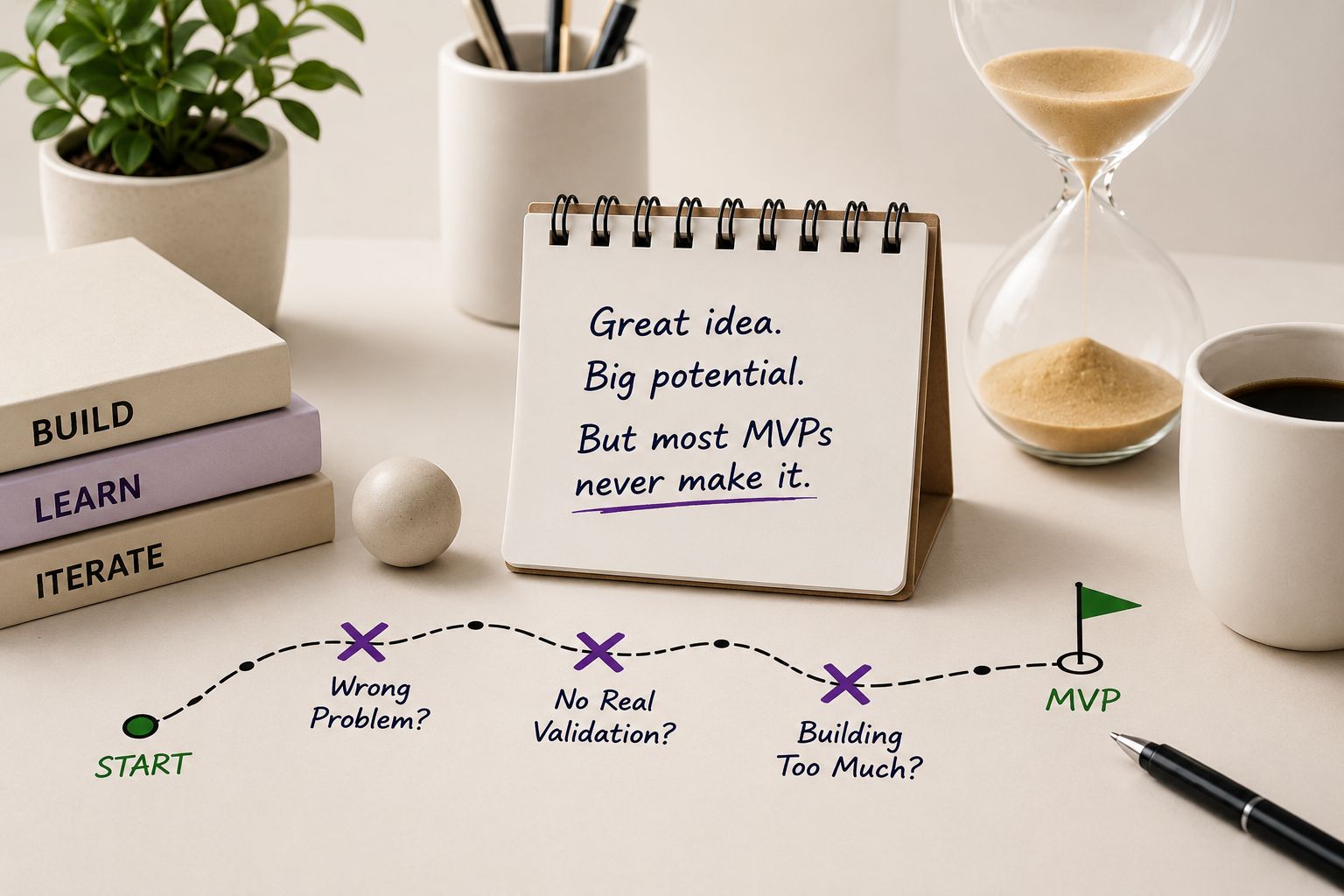

The Eulogy Nobody Wants to Give
Let's start at the end.
The product is dead. Not killed - it just stopped breathing somewhere around month nine. The founder knows it. He has known it for a while. But he's still running the last few meetings, still responding to the three users who occasionally log in, still telling his mother that things are 'picking up.'
This is not a failure story.
This is a love story.
And love, when it is misdirected, is the most expensive thing a founder can carry.
Every founder reading this has a version of this product in their history. Maybe it was an edtech platform. Maybe a SaaS tool for small businesses. Maybe a marketplace that made perfect sense on a whiteboard. They gave it a year - sometimes more. They skipped weddings. They delayed the apartment move. They told their parents it was going to work out. They meant every word of it.
And the world told them, quietly and without cruelty, that it didn't need what they had built.
Today, a new wave of tools promises to build your MVP in minutes. In hours. With a single prompt. And they can. The problem isn't the speed. The problem is that they make it faster to build the wrong thing with total confidence. Gartner's Hype Cycle maps this perfectly: every new technology races through a Peak of Inflated Expectations before hitting a Trough of Disillusionment. These tools have just compressed that journey. Same cliff, higher speed.
The mistakes this article is about are not technical mistakes. They are not mistakes of execution. They are mistakes of proximity - of being so close to your own idea that you lose the ability to see it the way the market sees it. And they are mistakes that repeat founders make more often than first-timers, because the second time you build, you think you already know.
You do not. Not yet.
These three mistakes can be spotted in Week 1 - if you know what to look for. Here they are.
Before the MVP: You Were the First MVP
Most founders think their startup journey started the day they registered the company. It didn't. It started the day they took their first job.
Think about it this way. Your employment was a business. You had a revenue stream - your salary. You had a cost structure - your time, your energy, your commute, your growth foregone. You had a profit and loss statement - whether the return on your effort felt worth it or not. You were, in the truest sense, a one-person company operating inside a larger one.
The question is: did you validate that business?
Most founders who build a second or third product still carry the instinct of the first-time employee - someone who was told what to build, what to prioritize, and who the customer was. When they go out on their own, they replicate that instinct. They decide what to build. They decide what to prioritize. They assume they know who the customer is. They've just replaced one boss with another - themselves.
Peter Thiel, in Zero to One, asks founders one question that almost none of them can answer cleanly: What valuable company is nobody building? Most founders skip this question entirely. They're too close to their own pain point to ask it. That closeness is the root of all three mistakes that follow.
The founder is himself an MVP - an early version of something that needs to be tested, iterated, and validated before it can be scaled into a product company.
Mistake 1: You Built for Yourself
Your MVP has one user.
You.
And you are the most biased user on earth.
A founder we worked with spent eight months building a project management tool. His reason was honest - he'd tried every existing tool and found them confusing. He understood the problem deeply. He cared about it. He built it with genuine conviction. At launch, his first ten users used exactly two of the fourteen features he had shipped. The other twelve? Features he personally wanted.
This is not an unusual story. It is the most common story in early-stage product development.
The Lean Startup methodology, which most founders have read but fewer have internalized, makes this point directly: an MVP is 'a version of a new product which allows a team to collect the maximum amount of validated learning about customers with the least effort.' Eric Ries adds a rule of thumb that very few founders follow - take your first idea for an MVP, cut it in half, then cut it in half again. Most founders do the exact opposite.
There is a reason for this. The feature list of a founder's MVP is not really a product roadmap. It is a self-portrait. Every feature is a belief the founder holds about how the world should work. Stripping features feels like stripping conviction. So they don't strip them. They ship a product that reflects everything they believe, and then they wait for the world to validate it.
Marc Andreessen, writing on product-market fit at a16z, describes what it feels like when you have found it: customers are buying as fast as you can make it, money is piling up, reporters are calling. That feeling has a direct opposite - and founders who have built for themselves know it well. The customers are not quite getting value. Word of mouth is not spreading. Usage is flat. You can always feel the absence of product-market fit too.
A CB Insights post-mortem of 101 failed startups found that 42% cited 'no market need' as the primary cause of failure. Not competition. Not funding. Not team. The market simply did not need what was built. This is not a market problem. It is a listening problem.
Lenny Rachitsky interviewed 25 iconic founders to ask them when they first knew they had product-market fit. Every single one described the same thing: a shift from push to pull. They stopped chasing users. Users started pulling the product toward them. The founders in this article have never felt that pull. They have always been pushing.
Week 1 signal: Who are you actually talking to outside of yourself? If the answer involves fewer than five real conversations with people who are not your friends, you have not left your own head yet.
Mistake 2: You Confused Stubbornness With Vision
There is a concept in Indian strategic thought - साम दाम दंड भेद - four methods from Chanakya's Arthashastra that describe how power is exercised in the real world. Persuade. Incentivize. Punish. Divide. Chanakya used these to advise Chandragupta Maurya in building one of the largest empires in Indian history. They are as relevant in a startup sales conversation as they were in Mauryan statecraft.
Most repeat founders understand these tactics intellectually. They can name them. They have seen them used on themselves - by vendors, investors, co-founders. But there is a gap between knowing the tactics and being willing to use them. And that gap comes from a value system that is not aligned with the reality of how business is actually conducted in India.
The more dangerous version of this gap, however, is not that the founder fails to use these tactics outward. It is that he turns them inward.
He persuades himself that the market will come. He incentivizes himself to keep going by moving the goalposts - one more feature, one more month, one more redesign. He punishes himself financially - drawing down savings, delaying his sister's tuition, skipping the family trip. And he divides his own judgment - the part of him that sees the truth from the part that cannot afford to believe it.
Kevin Systrom built Burbn - a cluttered check-in app with a dozen features. Users kept ignoring almost all of them and using one thing: photo sharing. He killed 90% of his own product, kept the one thing users actually wanted, and relaunched as Instagram. That single act of letting go - of choosing the market's signal over his own attachment - made him a billionaire. Most founders cannot do this. Not because they lack intelligence. Because killing the product feels like killing the proof.
For a founder without a safety net, the MVP is not just a product. It is evidence. Proof to his parents, to his college batchmates, to the society that has been watching and waiting. Shutting it down does not feel like a pivot. It feels like an admission that he was never good enough to begin with.
Brian Balfour, founder of Reforge and former VP of Growth at HubSpot, writes specifically about this pattern in repeat founders: they have a bias to overcorrect for mistakes from prior companies. They apply the lesson from the wrong failure. They mistake stubbornness for the conviction that carries successful founders through.
The difference between conviction and stubbornness is simple. Conviction changes what you are willing to do. Stubbornness changes what you are willing to see.
And in the background of all of this: the silence at home. Papa ne kuch nahi kaha. But you can see it in his eyes every morning when he watches you open your laptop. Your partner has been patient. That patience has an expiry date and you both know it. The society outside does not ask directly. It asks through the cousin who got promoted, through the classmate whose wedding invitation arrived with a job title on it, through the aunty who says 'so what are you building these days?' with a smile that asks something else entirely.
That pressure does not make a founder stop. It makes him push harder in the wrong direction. It makes stubbornness look like strength.
Week 1 signal: Are you iterating based on what users are telling you, or are you holding firm on a decision you made before you spoke to anyone? If users are giving you feedback and your response is to add another feature rather than remove one, you are applying force inward.
Mistake 3: You Never Learned to Sell Before You Built
'I am a builder, not a salesman.'
This is the sentence that costs founders a year. Sometimes two.
Every founder says some version of it. And the irony is that the most successful founders in history were, above everything else, salespeople. They sold ideas before products existed. They sold belief before there was evidence. They sold themselves before there was a company.
Patrick Collison, co-founder of Stripe, understood this intuitively. When Stripe was in beta at Y Combinator, he did not send links. He walked up to fellow founders, asked for their laptop, and set up Stripe for them on the spot. This became known in YC circles as the 'Collison Installation.' It was manual. It was unscalable. It was also how you learn, in real time, what your product actually needs.
Paul Graham, in his essay 'Do Things That Don't Scale', makes this the central point: the most common unscalable thing founders must do at the start is recruit users manually. Nearly all startups have to. You cannot wait for users to come to you. You have to go out and get them, face to face, one conversation at a time. The founders who skip this step are not saving time. They are skipping the only source of signal that actually matters.
In the Indian context, this matters even more. Business in India runs on relationships, not forms. It runs on trust built through conversation, through showing up, through the kind of presence that a landing page cannot manufacture. The market does not reward the best product. It rewards the product people believe in. And belief is a sales job.
Nithin Kamath built Zerodha - India's largest brokerage - without a single rupee of external funding. Before writing a line of product code, he spent years running Yahoo Messenger and Orkut trading groups, validating demand through community conversation. He was not building in silence. He was selling long before there was anything to sell.
The question is not 'can I build this?' The question is 'has anyone agreed to pay for this before I write a single line of code?'
Week 1 signal: Has anyone outside your immediate circle committed real signal - time, money, or a signed intent - to what you are building? If you have only positive verbal reactions but no one has parted with anything, you do not have validation. You have encouragement.
You Are Not Behind. You Are Repeating.
Here is what makes repeat founders different from first-timers, and not in the way they think.
A first-time founder makes these mistakes because they do not know better. A repeat founder makes them because knowing better has not changed what they feel. The knowledge is there. The pattern is there. The willingness to act on it - that is where the gap lives.
Between January 2023 and October 2025, over 39,860 startups failed in India. 2025 alone saw 11,220 closures - thirty startups shutting down every single day. Behind each of those closures is a founder who believed, who tried, and who ran into a version of one of these three mistakes.
The statistics on repeat founders are worth sitting with. A first-time founder has an 18% chance of success. A founder with one failed venture has a 20% chance. Two percentage points. The experience of failure, on its own, barely moves the needle. What moves the needle is changing the pattern - not just trying again.
Steve Jobs was fired from Apple in 1985. He was 30 years old. He spent the next twelve years building NeXT and Pixar - away from the product he had been most attached to, away from the company he had started. When he returned to Apple in 1997, the company was near bankruptcy. Within a year he launched the iMac. A decade later, the iPhone. In his Stanford commencement address he said: 'The heaviness of being successful was replaced by the lightness of being a beginner again.' The distance from his own product did not weaken him. It was what made him great.
The Gartner Hype Cycle maps the journey every new technology takes: from an Innovation Trigger to the Peak of Inflated Expectations, then into the Trough of Disillusionment. Most repeat founders' MVPs follow the exact same arc - except they never make it out of the Trough. The tools that promise to build your product in minutes have only accelerated the journey to the Peak. The Trough arrives faster than ever. And the way out of it has not changed.
It still requires distance. Honest signal. Selling before building. And the willingness to let the market tell you something you did not want to hear - in Week 1, not Month 9.
Recognizing the pattern is not defeat. It is the only thing that separates the founder who builds something that matters from the founder who builds something that mattered to him.
What Pythrust Does in Week 1
We work with repeat founders who are building again. We have seen these patterns many times - the feature list that is a self-portrait, the conviction that has quietly become stubbornness, the product that has never been sold to a stranger.
In the first week of working with us, we do not write a single line of code. We map the assumptions. We find the riskiest one. We design the smallest possible test that can validate or kill it - before a year of your life is committed to the answer.
This is not a sales pitch. It is a pattern check.
If any part of this article felt like looking in a mirror, the conversation is worth having.