

Most Agencies Get Paid Whether You Win or Lose
That is the part nobody says out loud. You sign a retainer, they deliver work, the invoice arrives at the end of the month - regardless of whether you got a single paying customer. The risk is yours. The payment is theirs.
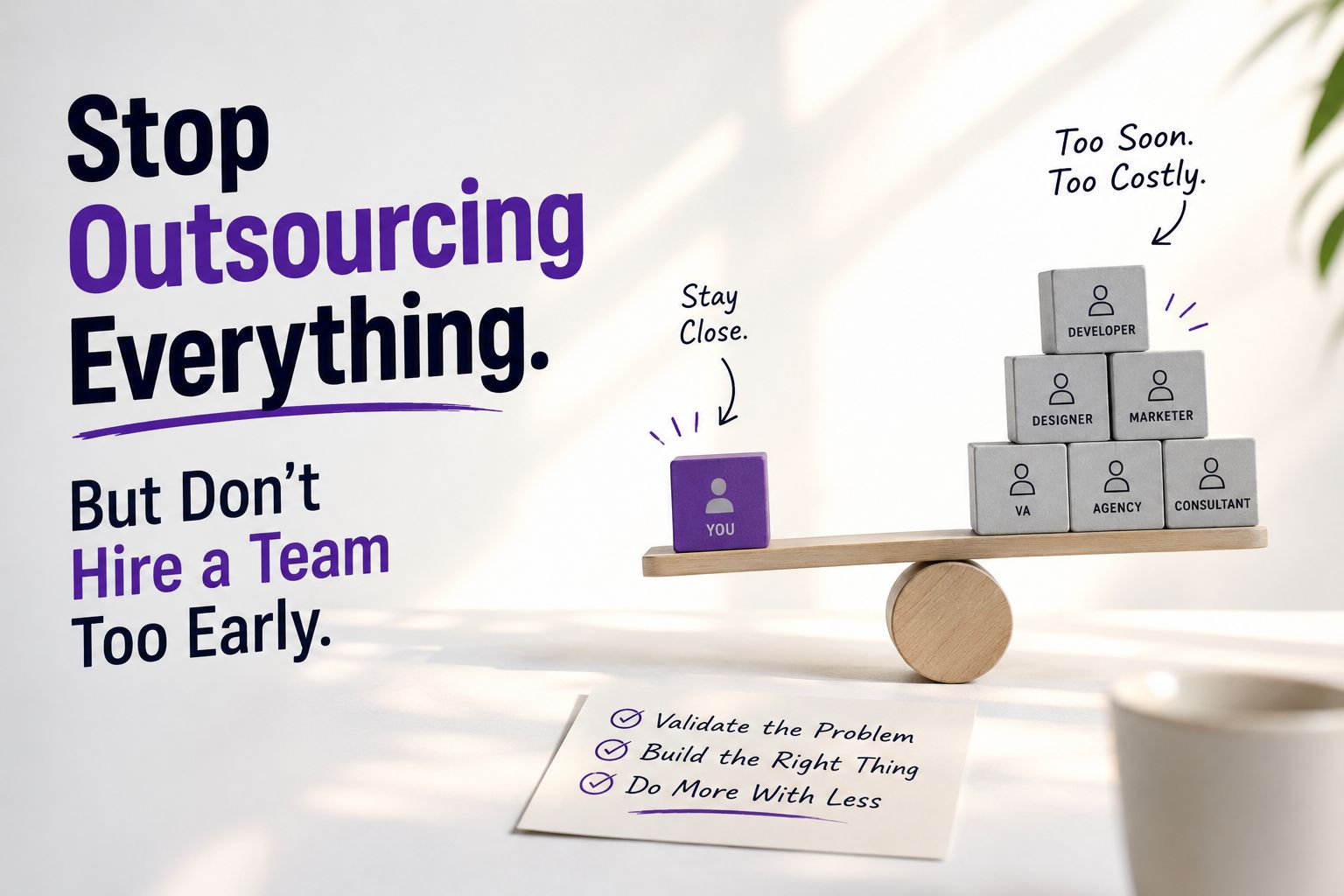
Most founders respond to this in one of two ways. They either outsource everything - development, marketing, accounts, ops - and watch their runway disappear into a dozen different vendors they cannot fully control. Or they panic and hire a team too early, locking in salaries before revenue exists to support them.
Both paths lead to the same place. 74% of high-growth startups fail due to premature scaling. The most common driver is not a bad product. It is a founder who made the wrong call on team and execution before the money was real.
There is a third way. It is not a shortcut. It is a model - and it is designed so you never carry salary burden before revenue exists to support it. Here is how it works, phase by phase.
Phase 1 - Pre-Revenue: Pythrust Builds, You Sell
Before your first paying customer, there is only one thing that matters: getting that customer. Amazon started in a garage with a team so small they used recycled doors as desks. Jeff Bezos did not hire ahead of revenue. He built lean, sold hard, and scaled headcount only when the business justified it - from a garage to 30,000 US employees over 17 years.
Andrew Grove, Intel's legendary CEO, argued in High Output Management that a manager's output is the output of their team. Before you have a team, your only job is to maximise your own output. For a pre-revenue founder, that output has one name: sales.
At this stage, Pythrust owns product development end-to-end. You are not managing developers, debugging sprints, or making architecture decisions. You are talking to customers, running demos, and closing your first deal. That is the only job that matters before revenue exists.
Do not hire a developer. Do not bring in a marketing agency. Do not outsource your accounts. None of that moves the needle before the first paid customer. The only thing that moves the needle is you, selling.
First Paid Customers: Stop the Outsourcing Creep
The MVP is live. You have your first paying customers. Now comes the most dangerous moment in the lifecycle - the outsourcing creep.
You finished the product build and it worked. So now you want to do the same with everything else. Marketing agency. Accountant. HR. Ops. Content. Social. It feels like momentum. It is actually fragmentation.
Consider ScaleFactor - a fintech startup that raised $103M promising AI-powered accounting for small businesses. Behind the scenes, the AI did not work. So they hired over 100 employees and outsourced their core bookkeeping function to a Philippines-based firm to manually do what the technology was supposed to do. Customers received error-filled books. The company shut down in 2020. The lesson: outsourcing the wrong things - especially your core product promise - is not a cost-saving move. It is a structural failure waiting to happen.
Compare that to WhatsApp, which had only 55 engineers before its $19B acquisition by Facebook. WhatsApp outsourced content delivery, traffic optimisation, and support infrastructure. But it kept core product engineering entirely in-house. The team that understood why the system was built the way it was never left the building.
That is the line. Keep one critical profile in-house - the person who owns the core architecture, the one whose knowledge cannot live outside the company. In a tech startup, that is typically the developer who understands the system at its deepest level. Everything else - the non-core execution - can be outsourced selectively.
For commodity operations - scheduling, research, drafting, admin - this is where Agentic AI earns its place. Gartner projects that by 2028, 33% of enterprise software will embed Agentic AI, up from less than 1% in 2024. Founders who adopt AI agents for ops now operate with the efficiency of a team twice their size - without the salary overhead.
As Peter Thiel argues in Zero to One: if your product has found something no one else has, do not dilute it by spreading your attention across ten vendors. Protect the core. Outsource the periphery. And keep Pythrust on product while you focus on revenue.
Revenue Growing: Hire One at a Time
This is where most founders make the most expensive mistake. Revenue is coming in. The instinct is to build the team fast - hire a developer, a marketer, a salesperson, a product manager. Fab.com hired 700 employees in under two years before validating their model. They burned through $200M of $336M in funding. By end of 2013, only 150 remained. CEO Jason Goldberg's own words: "We grew too fast, went international too fast, built out of warehouses too fast." They sold for a fraction of their $1B peak valuation.
The data is unambiguous. 38% of startup failures are linked to cash issues from premature team scaling. Payroll becomes the largest fixed cost long before revenue is predictable. Once you have salaried people and no revenue, there is no good outcome.
Ben Horowitz writes in The Hard Thing About Hard Things that every hire is a commitment. In a small company, one wrong hire can represent a meaningful percentage of your entire workforce - and destroy culture before you have even found your footing. Jim Collins, in Good to Great, found that great companies get the right people on the bus before deciding where to drive. Not many people. Not fast. Right.
The rule is simple: hire only when the revenue already justifies the salary. Not when it might. Not when the round comes in. When the income is already there.
One person at a time. One role at a time. Tied to a specific revenue milestone. If you cannot point to the number that funds this hire, the hire is too early.
And if cost-cutting becomes necessary - do not fire your whole team. Identify the critical profiles, the people whose knowledge cannot be reconstructed quickly, and protect those seats. Cut the periphery. Keep the core.
Team Augmentation: Pythrust Embeds, Then Exits
When you are ready to build your own product team, Pythrust does not disappear. We transition.
Through our team augmentation service, Pythrust places developers and designers directly with your company for a defined period. You pay them directly. There is a direct connection between the core profile and your team - no middleman, no account manager sitting between you and the person doing the work.
During this period, Pythrust steps back gradually. Knowledge transfers. Your team learns the system, the decisions, the architecture. The developers who were Pythrust's become yours - not through a handover document, but through working side by side until the transition is complete.
Then Pythrust exits cleanly. No dependency. No disruption. No crisis. You own the team. We leave.
This is what it means to take risk with you. We are not interested in locking you into a retainer. We are interested in building something that works - and then stepping back when you do not need us anymore.
The Model No Agency Will Tell You About
Most agencies are designed to keep you dependent. More retainers, more vendors, more scope. The incentive is continuity, not your independence.
Pythrust is built on the opposite assumption. The goal is to get you to the point where you do not need us - and to make sure you never pay for people before the revenue is there to support them.
Pre-revenue: we build, you sell. First customers: keep one critical person in-house, use AI for ops, Pythrust stays on product. Revenue growing: hire one at a time, only when income justifies it. Ready for a full team: we embed, transfer knowledge, and exit cleanly.
No salary burden before revenue. No firing crisis. No agency dependency. No premature team that collapses the moment fundraising stalls.
We take the risk with you. That is the model.
If you are trying to figure out what the right move is right now - outsource, hire, or something else -
book a call with Pythrust. We will help you find the answer.