
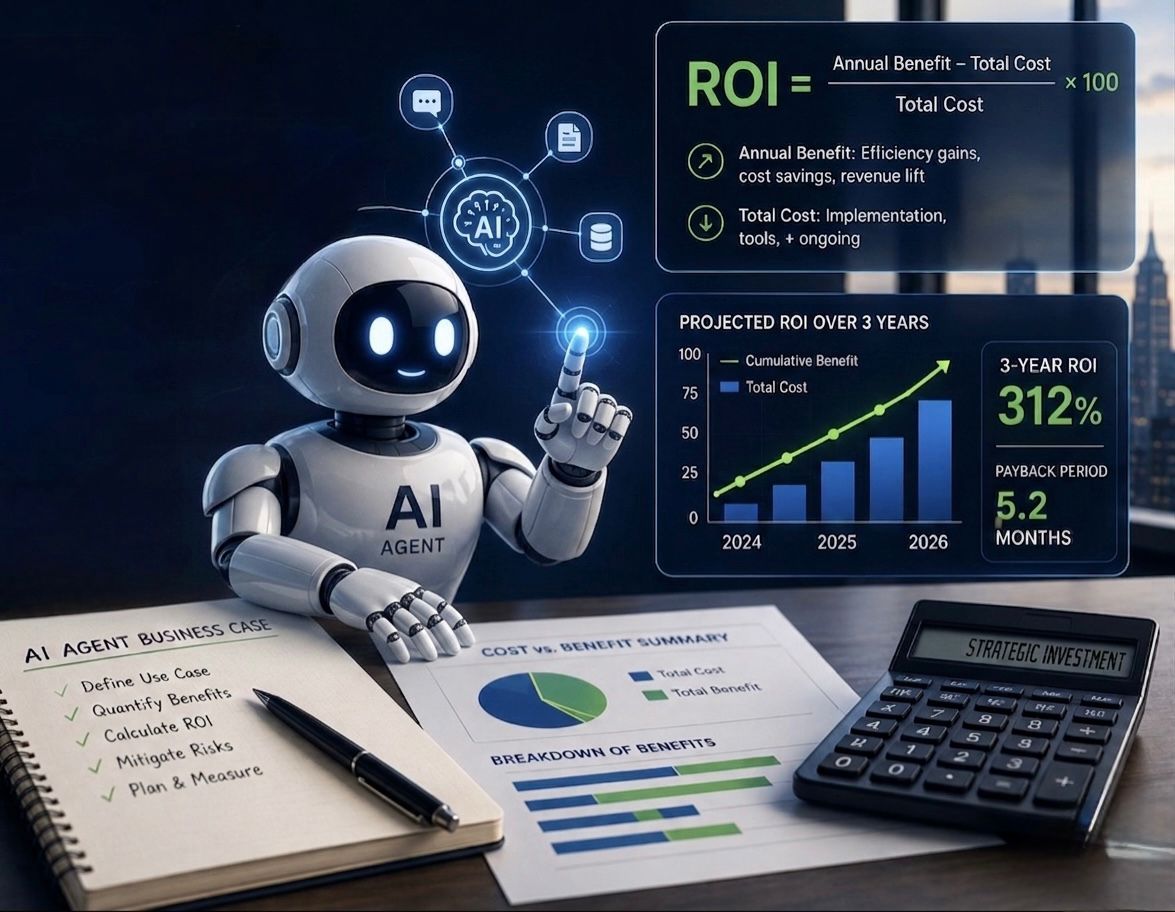

Every AI agent proposal ends up on the same desk. The CFO's.
The pitch arrives from the CTO, the operations head, or a vendor with a compelling demo. It talks about efficiency gains, automation rates, and competitive advantage. It has slides. It may even have a case study from a Silicon Valley company with a hundred engineers and a nine-figure technology budget.
And the CFO — correctly, rationally, professionally — asks one question: show me the numbers.
Most proposals cannot. They were built to impress, not to convince. They describe what an AI agent is capable of rather than what it will cost, what it will save, and how long the payback will take. They assume enthusiasm will carry the room. It does not.
The result is a pattern that is now familiar in boardrooms across India: the AI agent proposal goes into a second review cycle. Then a third. The CTO is asked to 'refine the business case.' Six months pass. The proposal is still in draft. And somewhere across town, a competitor who ran the same numbers and got a yes has been running their agent in production for four months.
The CFOs who approved AI agents in 2024 are presenting payback data in 2026. The ones who asked for more time to evaluate are still evaluating. The compounding advantage of 18 months of AI-driven efficiency is not something you can recover by catching up later.
This article is not another piece about why AI agents matter. You know they matter. This is the business case document that should have been in the room — built line by line, assumption by assumption, in the language a CFO speaks fluently and a vendor pitch rarely does.
The Cost of Waiting Is Not Zero — It Just Never Appears in the Proposal
There is a specific kind of financial reasoning that sounds conservative but is actually the most expensive mistake available. It goes like this: we will not spend money on this until we are certain it will work. The money we do not spend is money we have not lost.
This reasoning has a blind spot. It treats inaction as having no cost. It does not.
Every month a 50-person operations team processes invoices manually at the same error rate and the same cost per transaction is a month those numbers are not improving. Every month a competitor's agent is running, compounding efficiency gains that translate to lower cost-per-transaction, faster cycle times, and — in competitive markets — the ability to price more aggressively or retain margin while competitors cannot.
Nasscom's Digital Enterprise 2025 report found that 27% of Indian companies already have AI agents in production or at scale, with another 31% at the proof-of-concept stage. That means more than half of Indian enterprises in the sectors most exposed to AI disruption are either running agents or actively testing them. The CFO who is still 'evaluating' is not being conservative. They are being late.
Globally, the data is unambiguous. Companies report average ROI of 171% from agentic AI deployments — approximately three times the return of traditional automation. 74% of executives achieved ROI within the first year of AI agent deployment. 39% saw productivity at least double. These are not projections or estimates from vendors trying to close a deal. They are verified outcomes from production deployments, documented in case studies that name the company, specify the use case, and state the metric.
The CFO's job is not to block spend. It is to allocate capital to its best use. In 2026, for most mid-size Indian businesses with high-volume operational workflows, an AI agent is one of the highest-returning capital allocations available. The question is not whether the ROI is there. The question is whether the business case document shows it clearly enough to defend.
What a CFO Actually Needs to See — and What Most Proposals Skip
Before building the numbers, it is worth being clear about what a CFO is actually evaluating when an AI agent proposal lands on their desk. It is not a technology decision. The CFO does not care whether the system uses GPT-4 or Claude or a custom model. They are making a capital allocation decision under uncertainty, and they need four things to make it well.They need to know what the current process costs in full — not just the salary line, but the total cost including errors, delays, management overhead, and the opportunity cost of skilled people doing work a system should be doing. They need to know what the agent actually costs to build, deploy, and maintain — with no hidden items discovered after sign-off. They need a payback period stated in months, not in the language of 'we expect to see returns over time.' And they need to see the downside: what happens if adoption is half of what you projected, and is the outcome still positive.
Most proposals provide some of the first, understate the second, assume best-case for the third, and omit the fourth entirely.
Deloitte's analysis of AI ROI outcomes across 1,854 executives in Europe and the Middle East found that only 6% of organisations achieved AI payback in under a year — despite the technology being capable of delivering it. The gap is not in the AI. It is in how the business case is constructed, how the use case is scoped, and how the deployment is governed.
The CFO is not anti-AI. They are anti-vague. A proposal with four honest numbers beats a deck with twenty impressive slides every time.
Deloitte's CFO-specific AI guidance notes that 57% of finance executives are now among the top leaders driving AI strategy across their organisations — not blocking it, leading it. The CFOs who have moved from skeptic to sponsor are the ones who were given the numbers in a language they already speak: cost, payback, downside, and governance.
The ROI Calculation — Built Line by Line
Here is a real calculation. Not a template with placeholder percentages. A model built around a specific, realistic Indian business context that you can replace with your own numbers.
The scenario: a 50-person operations team at a mid-size Indian company. The use case: invoice processing. Currently 200 invoices per day, handled by four full-time employees, running at a 2% error rate, with a 48-hour average processing time. This is one of the most common and most clearly quantifiable AI agent deployments in Indian operations teams today.
Step one: the true cost of the current process
Most proposals start with the salary line and stop there. This is where the ROI gets underestimated, and where CFOs are right to push back — not because the number is wrong, but because it is incomplete.
Four FTEs at ₹8 lakh fully loaded annual cost each — accounting for salary, provident fund, health insurance, office space, and management time — is ₹32 lakh per year. That is the number that appears in most proposals as the 'current cost.' But it is not the full picture.
A 2% error rate on 200 invoices per day is four errors daily. If each error costs ₹2,000 to detect, correct, re-process, and communicate — a conservative estimate that excludes any downstream consequences — that is ₹8,000 per day, or approximately ₹29 lakh per year in error cost alone. Add the cost of a 48-hour processing cycle in delayed cash flow, vendor relationship friction, and the management time spent escalating exceptions, and the true annual cost of the current process is not ₹32 lakh. It is closer to ₹61 lakh.
The number that appears in most AI proposals as the 'cost we are solving' is the salary line. The number that actually matters is the total cost of the process — including errors, delays, and the opportunity cost of skilled people doing work that should be automated. The gap between these two numbers is where most business cases fail.
Step two: what the agent actually costs
A well-scoped invoice processing agent for this context — built to production standard, integrated with the company's ERP and accounts payable systems, tested across the full range of invoice types the business receives, and deployed with a fallback path for exceptions that require human review — costs between ₹8 lakh and ₹15 lakh to build, depending on integration complexity.
Monthly maintenance and hosting runs ₹25,000 to ₹50,000 depending on transaction volume and the infrastructure configuration chosen. Over a full year, including the build cost, the total cost of the agent in year one is ₹11 lakh at the low end and ₹21 lakh at the high end. From year two onward, with the build cost fully amortised, the annual cost drops to ₹3 lakh to ₹6 lakh.
That comparison alone — ₹61 lakh annual process cost versus ₹6 lakh ongoing agent cost from year two — is the business case. Everything else is supporting evidence.
The complete model
Line Item | Current (Without Agent) | With AI Agent |
|---|---|---|
FTEs on invoice processing | 4 FTEs × ₹8L = ₹32L/yr | 1 FTE oversight = ₹8L/yr |
Error cost (2% on 200 invoices/day) | ₹4 errors/day × ₹2,000 = ₹29L/yr | 0.1% error rate = ₹1.5L/yr |
Processing time per invoice | 48 hours average | 4 minutes |
Agent build cost (one-time) | — | ₹8–15L |
Monthly maintenance + hosting | — | ₹25,000–50,000/month |
Total year one cost | ₹61L+ | ₹21L (worst case) |
Total year two cost | ₹61L+ | ₹9.5L (maintenance only) |
Payback period | N/A | 4–5 months |
Downside scenario (50% adoption) | ₹61L | Still ₹5.5L net positive |
The payback period in this model is four to five months. The downside scenario — 50% adoption in the first year, with the agent handling half the volume it was designed for — still produces a net positive outcome. That is the number the CFO needs to see. Not because it is impressive, but because it is honest. And honesty is what earns a yes.
What changes in year two
The year-two economics of an AI agent are dramatically better than year one, and most proposals fail to show this because they present the build cost as a recurring cost rather than a one-time investment. From year two, the agent costs between ₹3 lakh and ₹6 lakh in maintenance and hosting. The three FTEs who were redeployed from invoice processing to higher-value work are still being paid, but they are generating value that was not possible before — strategic analysis, vendor relationship management, exception handling that requires genuine judgment.
The three-year total cost of ownership of the agent in this scenario is approximately ₹30–35 lakh. The three-year cost of maintaining the status quo is approximately ₹183 lakh — three years of ₹61 lakh in process cost. The question is not whether the agent delivers ROI. The question is how quickly the organisation can move past the evaluation and capture it.
The Four Mistakes That Kill AI Agent ROI Before It Starts
The data on AI agent failures is instructive. Gartner projects that over 40% of agentic AI projects are at risk of cancellation by 2027 due to weak business cases, high costs, or poor risk management. These failures are not evenly distributed across all types of deployments. They cluster around four specific mistakes that appear in proposals again and again.
Measuring only the salary saved, not the fully loaded cost
Salary is one component of process cost. Errors, delays, rework, management overhead, and the opportunity cost of skilled people doing unskilled work are the other components — and they are often larger than salary in high-volume operational workflows. A proposal that measures only headcount cost understates the ROI by 40 to 60 percent and makes it harder, not easier, to get approval.
Projecting 100% adoption in month one
No enterprise deployment reaches full adoption in the first month. Integration issues surface. Edge cases appear that were not in the test data. Users need time to develop the workflows around the new system. A proposal that projects 100% adoption from day one is immediately identifiable as optimistic, and optimism is the fastest way to lose a CFO's trust. Conservative projections — 60 to 70% adoption in the first six months, scaling to 85 to 90% by month twelve — are not just more honest. They are more persuasive.
Treating the build cost as the only cost
The build cost is the number on the invoice. The total cost of ownership includes monthly infrastructure and hosting, ongoing maintenance as the systems the agent integrates with change, periodic retraining as the volume and nature of inputs evolves, and the internal management time required to oversee the system. A proposal that shows only the build cost and ignores everything after it will produce a CFO who feels misled eighteen months after sign-off — and an organisation that becomes significantly more resistant to the next AI proposal.
Scoping the use case too broadly
The use cases that produce the clearest, fastest ROI from AI agents share a specific profile: high volume, repetitive structure, clearly defined inputs and outputs, and verifiable results. Invoice processing, customer query routing, claims triage, compliance document review — these are the workflows where 74% of organisations achieved ROI within year one. The use cases that fail are the ones scoped too broadly — 'automate our operations' rather than 'automate invoice processing for invoices under ₹5 lakh.' Narrow scope is not a limitation. It is the condition that makes payback fast enough to be defensible.
Six Questions Every Indian CFO Will Ask — and the Honest Answers
The following questions come up in almost every CFO conversation about AI agent deployment in India. The answers that earn a yes are not the most optimistic ones. They are the most honest ones.
What the CFO asks | The honest answer |
|---|---|
What is the payback period? | Under 12 months — model it conservatively using 60% adoption, not 100%. Show the CFO both scenarios. |
How does this compare to just hiring? | Fully loaded cost of a new hire is ₹10–14L/yr in India once you include salary, PF, office space, training, and management overhead. An agent costs ₹3–6L/yr from year two. The math is not close. |
What happens if it does not work? | Show the downside explicitly. If adoption is 50% of projected, is the outcome still positive? A well-scoped agent should be. If it is not, the scope is wrong. |
What are you assuming for adoption? | Conservative assumptions win CFO trust immediately. Never project 100% adoption in month one. 60–70% is defensible. 100% is a red flag. |
What is the total cost of ownership over 3 years? | Year one: build + maintenance. Year two and three: maintenance only. The 3-year TCO of a well-built agent almost always beats the equivalent headcount cost by year two. |
Who else in our industry has done this? | India-specific references carry more weight than global ones. If Pythrust has built similar systems in your sector, that is your answer. |
Gartner's survey of 183 CFOs and senior finance leaders, published in late 2025, found that 67% of those using AI in finance are more optimistic about it than they were a year ago. The organisations that overcame CFO skepticism did not do so with better demos. They did so with better answers to exactly these questions.
What Real Deployments Actually Look Like
Abstract ROI models are useful. Concrete examples are more useful. Here is what AI agent deployments at a comparable scale have produced in organisations that ran the numbers before moving.
Klarna's AI agent — the most publicly documented AI agent ROI case of 2025 — handled the workload equivalent of 853 employees in customer service, delivering a net saving of $40 million and a 4 to 7x return on investment. The ROI materialised within months, not years. The CEO published the numbers publicly. What made Klarna's deployment work was not the sophistication of the model — it was the discipline of the measurement. They tracked AI performance against human performance from day one, using resolution time, satisfaction scores, and accuracy rates. Every decision about where to expand the agent's role was driven by data, not by assumption.
JPMorgan Chase runs more than 450 AI use cases in production daily. AI initiatives have saved $1.5 billion in fraud prevention, trading, and operational efficiencies. More than 200,000 employees use the bank's internal LLM suite. The target for AI-driven business value has been raised to $2 billion annually. The discipline behind this is specific: every AI initiative undergoes controlled testing before full deployment, using test-and-control groups to quantify incremental benefit. The bank does not deploy AI to experiment. It deploys AI to hit a defined operational number.
These are large organisations with significant technology budgets. The lesson they offer is not about scale — it is about method. The companies seeing real ROI from AI agents are the ones that started narrow, measured everything, and expanded from a position of proven value. That method is available to any organisation, at any size, with any budget. The variable is not the resources. It is the discipline.
PwC's 2026 AI predictions report puts it directly: the organisations capturing AI value in 2026 are those where "senior leadership picks the spots for focused AI investments, looking for a few key workflows or business processes where payoffs from AI can be big — then applies the right enterprise muscle." Not broad transformation. Focused deployment. Defined payoff. Measured result.
The India Context: Why the Math Hits Differently Here
The global AI agent ROI data is instructive. But Indian CFOs are right to look for India-specific context — because the economics of AI agent deployment in India have characteristics that make the ROI argument both stronger and different from what the global case studies suggest.
Fully loaded employee costs in India are significantly lower than in the US or Europe. This means the absolute rupee savings from headcount redeployment are smaller in India than the global case studies suggest. But the cost of AI agent deployment — build, infrastructure, maintenance — is also lower in India, because the engineering talent building these systems is locally available at competitive rates. The ratio holds.
More importantly, the EY-Nasscom AI Maturity Index found that only 45% of Indian enterprises track advanced digital ROI metrics at all. This is both a problem and an opportunity. The problem: most Indian organisations do not yet have the measurement infrastructure to capture the value that AI agents generate. The opportunity: the organisations that build that infrastructure now — that instrument their processes before deploying agents, so they can measure the delta — will have both the ROI data to justify future investment and the organisational capability to compound it.
Nasscom's 2025 Digital Enterprise report shows 27% of Indian companies already running AI agents in production. The majority of those deployments are concentrated in BFSI, retail, healthcare, and industrials — the sectors where transaction volume is highest and the ROI from automation is most immediate. If your business operates in one of those sectors and you are still evaluating, you are not in the early majority. You are approaching the late majority. The window for building a structural advantage from being an early mover is narrowing.
Indian CFOs who are skeptical of AI ROI claims are not wrong to be skeptical of vague claims. They are right to demand specifics. The answer is not to make the claims less specific — it is to make the business case more rigorous. The rigour is what earns the yes.
The CFOs Who Moved Are Already Looking at the Returns
There is a version of this conversation that is happening right now in Indian boardrooms where the AI agent question is settled — not because the organisation figured out AI in some profound way, but because someone ran four honest numbers, checked the downside, and made the call.
The operations teams at those companies are processing the same invoices, handling the same customer queries, running the same compliance reviews — at a fraction of the error rate, in a fraction of the time, at a fraction of the cost. The three or four people who used to do that work are doing something that requires them: exception management, vendor negotiation, process design, the work that actually benefits from being done by a human who understands the business.
The CFOs at those companies are not presenting a hypothesis to their boards. They are presenting data. Month-on-month reduction in cost per transaction. Error rate trending toward zero. Processing time that used to be measured in days now measured in minutes. They approved a specific number, they tracked a specific outcome, and the outcome matched the number.
The CFOs who are still evaluating have the same information available. 88% of senior executives plan to increase AI-related budgets in the next 12 months specifically because of agentic AI, according to a PwC survey of 300 senior executives. The decision is not whether AI agents work. That question is settled. The decision is whether to build the business case with enough rigour to earn approval — and whether to do it this quarter or next quarter, knowing that every quarter of delay is a quarter of compounding advantage that accrues to a competitor who moved first.
The Last Thing Standing Between You and a Yes
The CFO in most Indian organisations is not the obstacle to AI agent adoption. They are the person who needs the right document in the right language, built on the right assumptions, with the downside scenario shown as clearly as the upside.
The obstacle is almost never the technology. The technology exists, it works, and the evidence for what it can deliver is extensive and public. The obstacle is the proposal — the gap between what the system can do and what the business case document makes credible.
Close that gap, and the approval follows.
The framework in this article — true current cost including errors and delays, honest agent cost including maintenance and hosting, conservative adoption projections, explicit downside scenario, three-year total cost of ownership — is the framework that earns a yes in a serious boardroom. Not because it is optimistic. Because it is rigorous.
Deloitte's guidance for CFO-led AI initiatives is consistent with this: the organisations capturing value from AI agents are those that "anchor AI initiatives to measurable business outcomes, design modular architectures for flexibility, and redefine talent strategies around human-machine collaboration." That anchoring starts with a business case built to withstand scrutiny. Not to survive a vendor pitch. To survive a CFO.
Your CFO will ask for the numbers. We will help you build them.
Pythrust works with founders, operations heads, and CFOs across India to scope AI agent deployments that have defensible ROI from day one. We build the agent and we help you build the business case — your numbers, your process, your industry.
One conversation. One honest ROI model. One clear answer on whether an AI agent makes sense for your business right now — and what the payback period looks like when the numbers are run honestly.
© 2026 Pythrust Technologies. All rights reserved. | Built in Gurugram, India.