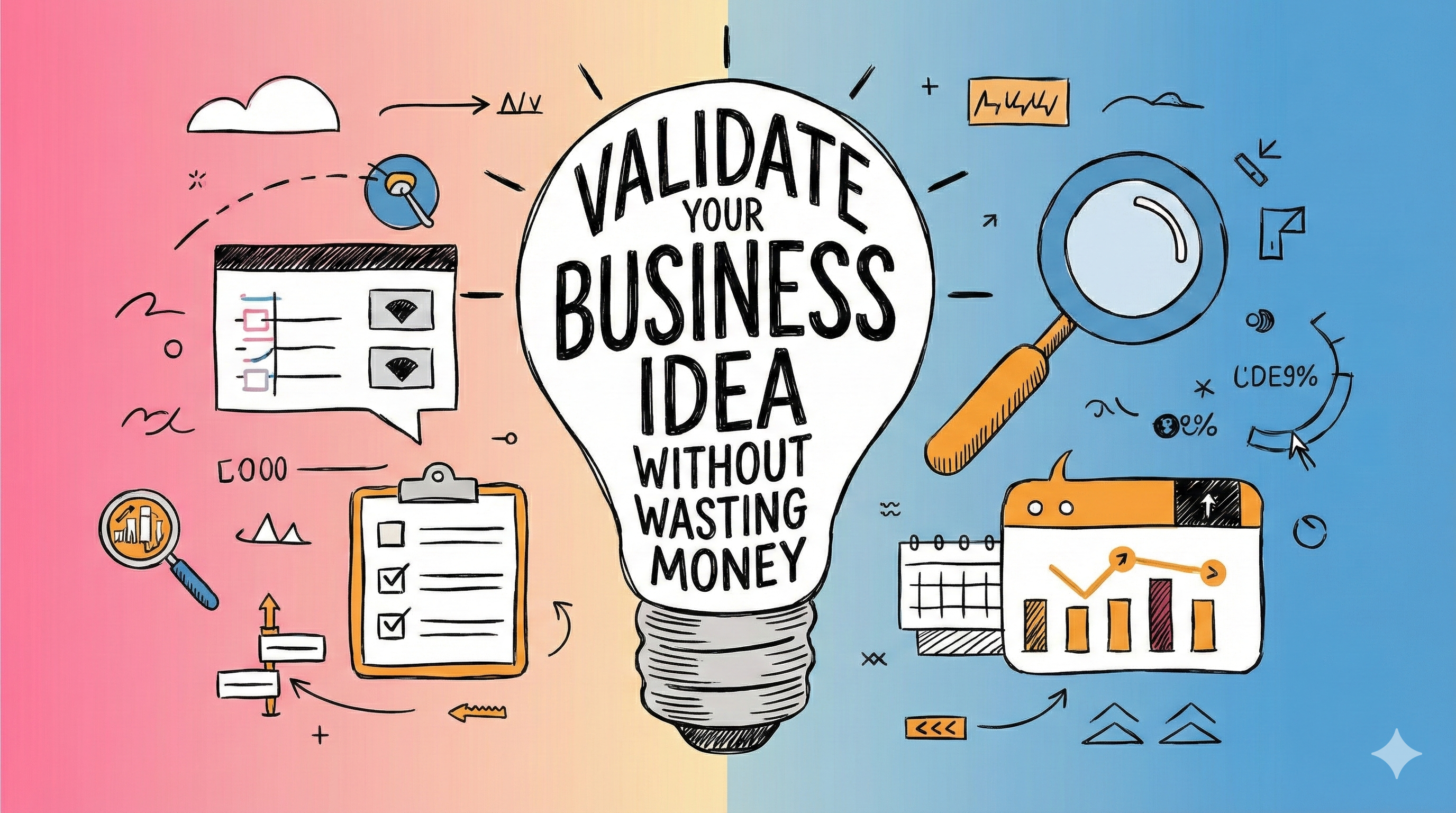

A Simple Guide to Validating Your Concept Early So You Don't Build Something Nobody Wants
The graveyard of failed startups is paved with good intentions and brilliant-sounding ideas that simply missed one crucial element: market need. Too many entrepreneurs operate under the "Field of Dreams" fallacy—"If you build it, they will come."1 In reality, building without validation is the fastest way to deplete capital, burn out your team, and create a product nobody wants or needs.
For early-stage startups, time and money are the most precious, and finite, resources. Wasting months developing a flawed concept is often a fatal blow. The solution is rigorous, structured, and lean validation. This process is about embracing uncertainty and seeking to disprove your assumptions before you spend a single dollar on coding.2
This guide provides a comprehensive, phased approach to product validation that maximizes learning while minimizing investment, ensuring your next big move is a confident, data-informed stride toward product-market fit.
Phase I: Problem Validation (The Crucial Starting Point)
Before you define your solution, you must definitively prove the existence and severity of the problem. This is where most startups fail—they have a solution looking for a problem.
1. Identify and Articulate the Core Problem (The Hypothesis)
Start by framing your idea as a testable hypothesis about the user's pain point.
Bad Hypothesis (Solution-Focused): "People need a better AI-powered scheduling app."
Good Hypothesis (Problem-Focused): "Small business owners waste 5+ hours per week on manual client scheduling, leading to $X in lost revenue due to double bookings and no-shows."
The good hypothesis is specific, quantifiable, and identifies the consequence of the problem. Your job in this phase is to validate the monetary or emotional cost of this pain.
2. The Power of Customer Interviews (The Unbiased Listener)
This is the single most valuable step. The goal is not to pitch your idea but to understand the user's life around the problem.
Target the Right Audience: Interview people who already experience the problem you aim to solve.
Ask Open-Ended Questions: Focus on past behavior, not future promises. Avoid questions like, "Would you use an app for this?" (They'll say yes to be nice). Instead, ask:
"Tell me about the last time you dealt with [the problem]."
"What workarounds do you currently use to solve this?"
"How much money/time does this problem cost you each week?"
"What have you tried in the past that failed?"
Look for Pain Signals: Listen for frustration, deep emotional language, or evidence of costly workarounds. If they’ve created a complex spreadsheet or pay for a clumsy service, the problem is real. If they shrug and say, "It's fine," the pain isn't significant enough.
Validation Threshold: You need to hear the same core pain articulated clearly by at least 15-20 target users before proceeding.
3. Competitor and Workaround Analysis
Your biggest competitor isn't necessarily another startup—it's often the status quo or a clunky workaround.
Analyze Existing Solutions: What are users doing right now to cope? (e.g., spreadsheets, email chains, paper notes).
Identify Gaps: Where do current tools—direct and indirect—fall short? This gap is your potential unique value proposition (UVP).
Phase II: Solution Validation (The Lean Test)
Once the problem is proven, you can move to testing your proposed solution's ability to solve that problem efficiently. This must be done before full development.
4. The Landing Page Test (Measuring Intent)
A landing page is the cheapest, fastest way to measure market interest and capture initial demand.
Simple Setup: Create a single webpage that describes the value proposition and the core benefit of your proposed solution (even if it doesn't exist yet). Use compelling headlines that speak directly to the validated pain point.
The Key Metric: The Sign-up Button: The only goal is to get visitors to click a button that says, "Join the Beta," "Get Early Access," or "Sign Up Now."
The Follow-up: When they click, send them to a page that says, "Thank you! We are currently in private beta. We’ll notify you when we launch." Crucially, you have captured their email.
Driving Traffic: Use targeted, small-budget ads (Google, Facebook, LinkedIn) or strategic posts in relevant forums to drive traffic to the page.
Validation Threshold: Track your conversion rate. A typical, high-intent landing page should aim for 10-15% conversion from relevant traffic to prove initial desire. If you can't get people to sign up for free, you won't get them to pay.
5. Mockups and Prototypes (The Visual Test)
You don't need code to test user experience. Tools like Figma, Sketch, or even PowerPoint allow you to create interactive prototypes that mimic the final product.3
Conduct Usability Tests: Sit down (virtually or in person) with 5-10 validated users. Give them tasks related to the problem (e.g., "Schedule a client in the app").
Observe Behavior: Watch how they try to complete the task. Where do they get confused? Where do they click incorrectly?
Refine the Core Loop: Use the feedback to simplify the user journey and ensure your proposed solution is intuitive and effectively addresses the validated pain point.
Validation Threshold: If 80% of users can complete the core tasks without guidance, your design is viable.
Phase III: Value Validation (The Monetization Test)
An idea that solves a problem is good; an idea that solves a problem people are willing to pay for is a business. This phase tests your pricing and willingness to pay (WTP).
6. The "Fake Door" Pricing Test (Testing the Wallet)
Building on the Landing Page Test, you now introduce tiered pricing options before the product is built.
Show Pricing Plans: Display different subscription tiers (e.g., Basic $10/month, Pro $30/month).
Monitor Clicks: When a user clicks a "Select Plan" button, they are then directed to the "Coming Soon/Beta" page.
Track Preference: Analyzing which plan tiers received the most clicks gives you strong data on perceived value and optimal pricing structure. Users will click on the plan they believe best matches the value of the solution.
Validation Threshold: You need a measurable percentage of users (e.g., 5-10% of sign-ups) to click a paid plan button to prove that the perceived value outweighs the perceived cost.
7. Concierge MVP (The Manual Solution)
The Concierge MVP is the ultimate lean validation method: you deliver your core service manually.4
Manual Delivery: Instead of coding the feature, you perform the core task for your first few users personally.
Example: If your product is an automated data aggregation tool, you manually pull and organize the data for the first ten clients and email them the report.
Deep Learning: This process forces you to intimately understand every step, friction point, and exception in the user journey. It provides deep qualitative insight that automation would hide.
Charge for the Service: Crucially, you must charge for this manual service. If people pay for the manual version, they will pay for the automated version.
Validation Threshold: Successfully acquiring 5-10 paying customers for your Concierge MVP proves not only the problem's severity but the commercial viability of your solution.5 This is the strongest form of validation.
Conclusion: The Validation Mindset
Product validation is not a one-time event; it is a continuous, iterative cycle.6 For startups, the ability to validate quickly and cheaply is the definition of efficiency.
By systematically proving your hypotheses—first the Problem, then the Solution, and finally the Value—you minimize your exposure to risk. You transform your brilliant idea from a hopeful gamble into an evidence-based product strategy, ensuring that when you finally commit your precious time and money, you are building precisely what the market is waiting for.
Embrace the lean mindset: Learn first, build second.