

The 11:47 PM Problem
It’s 11:47 PM on a Tuesday. You’re forty-three years old. You’ve built a real-estate business that did a few crore in revenue last year. Your laptop is open to three tabs.
Tab one: a Figma file a freelancer made for you two months ago. Your idea, finally drawn. Decent screens, a few flows. A modest cheque already spent.
Tab two: a quote from an agency. Six months. A number that made you close the tab twice. “Plus iterations.”
Tab three: ChatGPT. You’ve been typing into it for ninety minutes. Can you build an app from a Figma file? What is Cursor? What is Lovable? Can a non-technical founder make their own MVP now?
The answers are getting more interesting. And more dangerous.
Because somewhere between tab one and tab three, a thought has started forming that wasn’t there at 10 PM. Maybe I don’t need the agency. Maybe with these new AI tools, I can just… do this myself.
Stop.
That thought is the most expensive thought you will have this year. Not because it’s wrong about the tools — the tools really have changed. Figma now ships a feature called Figma Make that turns design files into working code. Cursor is used by more than half the Fortune 500. v0, Lovable, Bolt — the design-to-deployed pipeline has collapsed from six months to six weeks. All of that is real.
It’s the conclusion that’s wrong.
The conclusion that AI tools moved the build onto your desk is the same mistake first-time founders have made for fifty years, just with a new costume. The old version was “I’ll hire a CTO.” The 2019 version was “I’ll use no-code.” The 2026 version is “I’ll prompt my way to a product.”
Each one ends the same way: nine months later, a half-finished thing, a founder who can’t sell because they’ve been debugging, and a competitor who launched.
Here is the actual shift, and it is bigger than the one you’re seeing in those AI tabs:
The build got cheap. Your time didn’t.
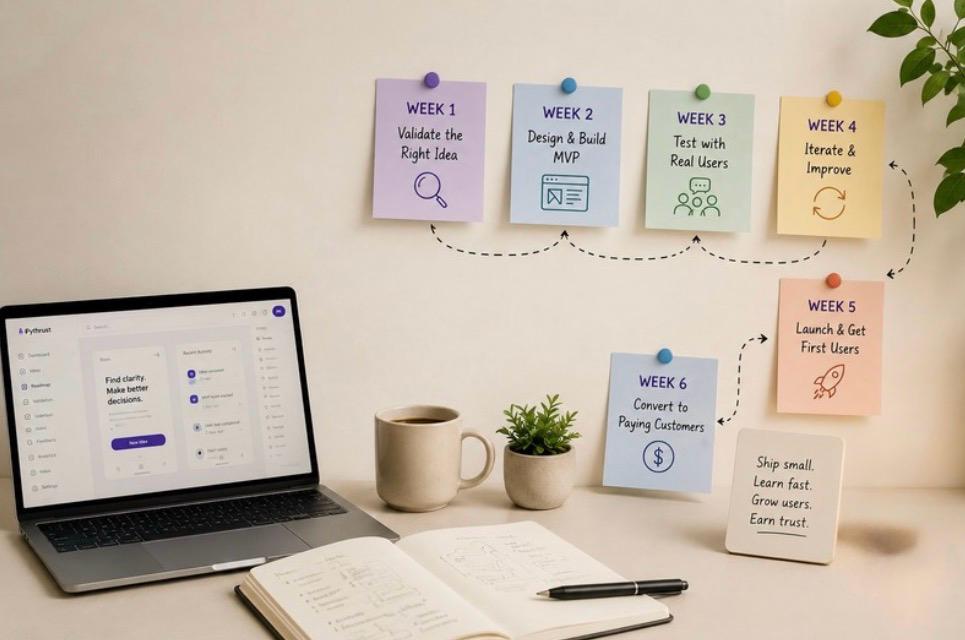
Six weeks from Figma to first paying customer is now real. But only if the founder runs sales while a build partner runs the build. The founders who try to do both — who treat AI as a way to do it themselves — lose to the founders who treat AI as a way to finally outsource the build without losing six months.
This playbook is what the second group does. Week by week. With the job split made explicit, the customer conversations made non-negotiable, and the math on why your time is the most expensive line item in this whole equation.
Close tab three. Read this instead.
What Actually Changed in the Last 18 Months
For two decades, the rough equation for getting from idea to working software looked the same. Write a brief. Hire a designer. Wait. Approve mockups. Hire developers. Wait longer. Stage. Test. Deploy. Six months if everything went right. Twelve if it didn’t. Twenty-four if you hired the wrong agency and had to start over — which, statistically, most first-time founders did at least once.
That equation has broken.
It has not been “disrupted” in the LinkedIn-keynote sense of the word. It has been physically rewritten by a layer of tools that did not exist eighteen months ago. Four specific compressions have happened, and they compound on each other.
The first compression is design iteration. Figma launched Figma Make in May 2025 — a feature that lets you describe an idea or upload a Figma file and have an AI model generate working code from it. It runs on Anthropic’s Claude 3.7 Sonnet under the hood. The same design file that used to sit in a “Pending Dev Handoff” folder for three weeks now becomes a clickable, hostable prototype in an afternoon. v0 from Vercel and Lovable do the same thing from a text prompt. The “design to working software” gap has collapsed from weeks to hours.
The second compression is scaffolding and coding speed. Cursor, the AI-first code editor, crossed one million daily active users in 2025 and is now used in more than half of the Fortune 500. JetBrains’ January 2026 developer survey found that 74% of developers worldwide had adopted specialized AI tools for development, with Stack Overflow’s 2025 data confirming that 84% of professional developers either use or plan to use AI tools in their daily workflow. This is not a fringe trend. This is the new default. And it is producing measurable productivity gains: developers report 30 to 50% reductions in development cycles on full-stack projects, with 20 to 25% time savings on routine debugging and refactoring.
The third compression is deployment and infrastructure. Vercel, Render, Supabase, Firebase, Cloudflare — the stack that used to require a DevOps hire now runs on managed services with one-click deployments and built-in auth, databases, and payments. A working MVP can be live, on a custom domain, with users logging in, in a single afternoon.
The fourth compression is usability testing itself. This is the one most founders miss. With AI-generated working prototypes, you can run real usability tests in Week 2 instead of Week 14. You can put a clickable, functional product in front of ten potential users and watch where they get stuck — not a Figma file they have to imagine clicking through. The research literature has long held that perception is an active, subjective process and that users learn the designed actions of new products on a case-by-case basis. Both findings make one thing obvious: real interaction beats hypothetical interaction every time. AI tooling moves “real interaction” from late-stage to week two.
There is a reason all four compressions are happening together. The same underlying frontier model — the one inside Figma Make, the one inside Cursor, the one inside ChatGPT — is now capable enough to do the work that used to require three specialized roles. Designer-to-developer handoff is now one tool. Frontend-to-backend wiring is now one prompt. QA-to-deploy is now one button. The roles still exist. They’re just operated by fewer people, faster.
This is also why AI-generated MVPs no longer look like the no-code Frankensteins of 2019. The principles inside books like Refactoring UI by Adam Wathan and Steve Schoger and the timeless rules from Dieter Rams — minimalism, contrast, hierarchy, “as little design as possible” — are now patterns the model has internalized. AI tools default to clean, sleek, modern interfaces because that’s what their training data rewards. Your MVP, built right, will not look like a 2019 no-code app. It will look like a product.
So yes, six weeks from Figma to first paying customer is real. The tooling is real. The compression is real. The productivity gains are documented.
And this is exactly where most founders draw the wrong conclusion.
The Trap: Why “I’ll Just Build It Myself” Kills the Company
Here is the trap, stated plainly: because the tools got dramatically faster, the founder thinks the build moved onto their desk.
It did not. The build got faster for people who already operate these tools daily. For a 45-year-old domain expert who has spent two decades selling real estate, training teachers, or running a chain of clinics, the AI tools are not friction-free. They are friction with a different costume.
Watch what happens when a non-technical founder tries to “just build it myself” with Cursor and Lovable in 2026. Week one is exhilarating. Two days in, there are screens. There is a button that does a thing. The founder shows it to their spouse. There is a moment of “I built this.” That moment is the most expensive moment in the project. Because by week three, the screens that worked in isolation don’t work together. By week five, there’s an authentication bug the founder cannot debug because they don’t know what authentication actually is. By week seven, the founder is in a Discord server at 1 AM asking strangers for help with a Supabase row-level-security error. By week ten, they have not made a single sales call in two months. By week sixteen, they hire an agency to “fix what’s there.” The agency quietly throws it away and rebuilds from scratch.
This is not a hypothetical. This is the most common path we see when a domain-champion founder tries to operate a developer toolchain. And the worst part is that the first two weeks always feel like progress.
There are four hidden costs to founder-built MVPs, and they compound silently.
Cost one: the opportunity cost of the sales calls you didn’t make. Peter Thiel says it directly in Zero to One: “Most businesses get zero distribution channels to work; poor sales rather than bad product is the most common cause of failure.” This is the most important sentence in startup literature, and it is the one founders ignore most aggressively. Every hour you spend prompting v0 is an hour you did not spend in a customer conversation. Your competitive advantage as a domain-champion founder is not your ability to code. It is your network, your credibility, and your domain instinct — none of which compounds when you’re debugging React.
Cost two: the quality ceiling on what you can ship. AI tools will get you to “looks like a product” within days. They will not get you to “is a reliable product” within weeks. The gap between a demo that wows your cousin and a product that survives ten paying customers using it daily is filled with edge cases, error states, race conditions, data validation, and operational discipline. None of those are vibe-codable in a Friday-night session. Founders who don’t know this ship things that break on first contact with real users — and the failure is read as “the idea is bad” instead of “the build was rushed.”
Cost three: iteration debt. When the founder builds the first version themselves, they accumulate technical debt they cannot see and cannot pay down. By the time real customers start using it and feedback comes in — “the onboarding is confusing,” “payments don’t work in incognito” — the founder cannot fix it, because they don’t have a mental model of how the system they prompted together actually works. They have to choose between freezing the product or hiring help to rebuild. Both are slow.
Cost four: the hire-back tax. The founders who go this route almost always end up bringing in an agency or a senior developer six months later — and the first thing the new team does is delete the founder’s code. Not because they’re being mean. Because rebuilding from scratch is faster than understanding a codebase that was prompt-engineered into existence by someone who couldn’t read what was being generated. The founder pays twice: once for their own time spent building it, once for someone else to throw it away and start over.
History has been generous with cautionary tales here, and they are not new. Pets.com became the symbol of dot-com collapse not because the product didn’t work — the website worked fine — but because the company couldn’t make the distribution math add up. They had a Super Bowl ad. They had a functioning e-commerce platform. They did not have a viable customer acquisition cost. The business model failed; the build was never the problem. Juicero — over $120 million raised, beautiful industrial-design product — failed because the founder fell in love with the engineering and never validated that the market actually needed an expensive juice press when customers realized they could squeeze the packs by hand. Both companies had product. Neither had distribution that worked at their cost structure.
The data backs this up brutally. CB Insights, which has tracked startup post-mortems for over a decade, finds that 42% of startups fail because there is no market need for what they built. That is the number one cause. It is not “the code was bad.” It is not “we couldn’t ship fast enough.” It is “we built the wrong thing for a market that didn’t exist.” The only way to avoid this failure mode is for the founder to spend the early weeks of the project in customer conversations — validating, listening, adjusting — not in a code editor.
The same CB Insights data shows that 23% of failed startups cite “not the right team” as a primary cause, with the common refrain being “the founding team couldn’t build an MVP on its own.” This is the data point that tempts the AI-era founder. Great — now I can build it on my own! But read the post-mortem more carefully. The lesson was never “founders should learn to code.” The lesson was always “founders without a way to ship a product die.” In 2026, the “way to ship a product” is renting an AI-native build partner — not learning Cursor at 45.
There is one client story we’ve seen play out so often it now feels like a script. A domain-champion founder, deep in their industry, decides in late 2025 to “use the AI tools and just do it myself.” Five months later, they call us. Their pitch is the same every time: “I’ve got most of it built, I just need help finishing it.” We look at what they have. Half the time, we have to tell them gently that there is nothing salvageable. The other half, we tell them the bigger problem: while they were building, three competitors signed deals.
The trap isn’t that AI tools are bad. The trap is that they are good enough to make a founder feel productive while making no progress on the things that actually determine whether the company survives.
The New Split: What You Own vs. What Your Build Partner Owns
The right way to use AI tooling in 2026 is not to absorb the build onto your desk. It is to make the build so fast — through a partner who operates these tools daily — that you can focus full-time on the only things only you can do.
This is the new split, and it only works because AI made the right side of the table dramatically faster. Without that compression, the math didn’t work; agencies took six months and founders were forced to micromanage just to survive. With it, the math works for the first time in startup history.
The founder owns | The build partner owns |
Customer conversations (5/week min) Sales conviction & positioning Distribution strategy Domain judgment calls Pricing & packaging | Design rebuild for AI compilation Scaffolding & core flows Auth, payments, deployment Usability test cycles 24–48 hour iteration loops |
Look at the split. It is not “founder does the easy stuff, partner does the hard stuff.” Both sides are hard. They are just different kinds of hard. The founder side compounds with twenty years of domain experience. The partner side compounds with thousands of hours operating modern AI tooling. Forcing one person to do both — which is what the founder-DIY path attempts — produces a worse version of each.
Paul Graham wrote in 2013 that founders must do things that don’t scale, and that one of the most important is personally recruiting your first users. That essay was written before AI tools changed the build economics. It is more true now than it was then. The founder’s job — the irreplaceable job — is to be the first salesperson, the first customer-service person, the first community manager. AI tools cannot do those jobs, and a build partner shouldn’t. Every hour the founder spends not doing those jobs is an hour the company is dying quietly.
This is the synthesis. AI compressed the build. The founder’s job didn’t change — it just finally has room to actually get done.
The next pages are what this split looks like, week by week, when you run it.
Download the Playbook