From Ambiguity to a Live Product
Indian Startup School needed a learning platform its first cohort could actually use, fast, with no engineering team of its own. Pythrust built and launched the LMS, wired applications straight into Salesforce, and turned 100+ startup evaluations into the research that shaped the product.

The situation
Indian Startup School (ISS) is a Gurugram-based school for first-time founders, run as intensive, in-person cohorts that take people from a raw idea to a validated MVP and an investor-ready pitch. The program was growing fast and drawing serious attention. What it did not yet have was a digital product to match: no learning platform its founders could actually log into and use, an application and grant funnel that leaked leads into spreadsheets, and a lean team doing far too much by hand.
This is the trap most early-stage organisations fall into. Big product ambition, a fixed deadline, a batch about to start, and no engineering muscle to build any of it. The usual answer, a large agency with a three-month discovery phase, is too slow and too expensive for the moment you are actually in. ISS did not need a discovery deck. It needed the product built and in founders’ hands before the next cohort walked in.
What “done” had to look like
A learning platform the first batch could use from day one, not a prototype living inside a slide.
An application and Idea Stage Grant funnel that fed a real CRM instead of a spreadsheet.
Automation, so a small team was not buried in manual follow-up as volume grew.
The constraints were the hard part. Requirements were ambiguous and moving. The batch start date was fixed. And the whole thing had to run on the tools ISS already used, not a new stack nobody had time to learn.
How we worked
This is the part worth paying attention to, because it is how we work with everyone.
Use-case first, not spec-first. Instead of specifying a cathedral, we found the handful of things the platform genuinely had to do for a founder inside a live cohort, and built those first. Everything else waited until it earned its place.
Research folded into delivery. We evaluated more than 100 startups applying to ISS. That evaluation doubled as 100+ user interviews, so the platform was shaped by what real founders needed, not by our assumptions. The same work that moved ISS’s pipeline forward also de-risked the product.
AI-native build. We used rapid, AI-assisted prototyping to compress build cycles from weeks into days, iterating in the open rather than disappearing for a quarter and hoping the brief still held.
Integrate, don’t reinvent. We wired everything into the stack ISS already ran on, Salesforce for leads and Google for email, so nobody had to adopt or pay for another tool.
What we shipped
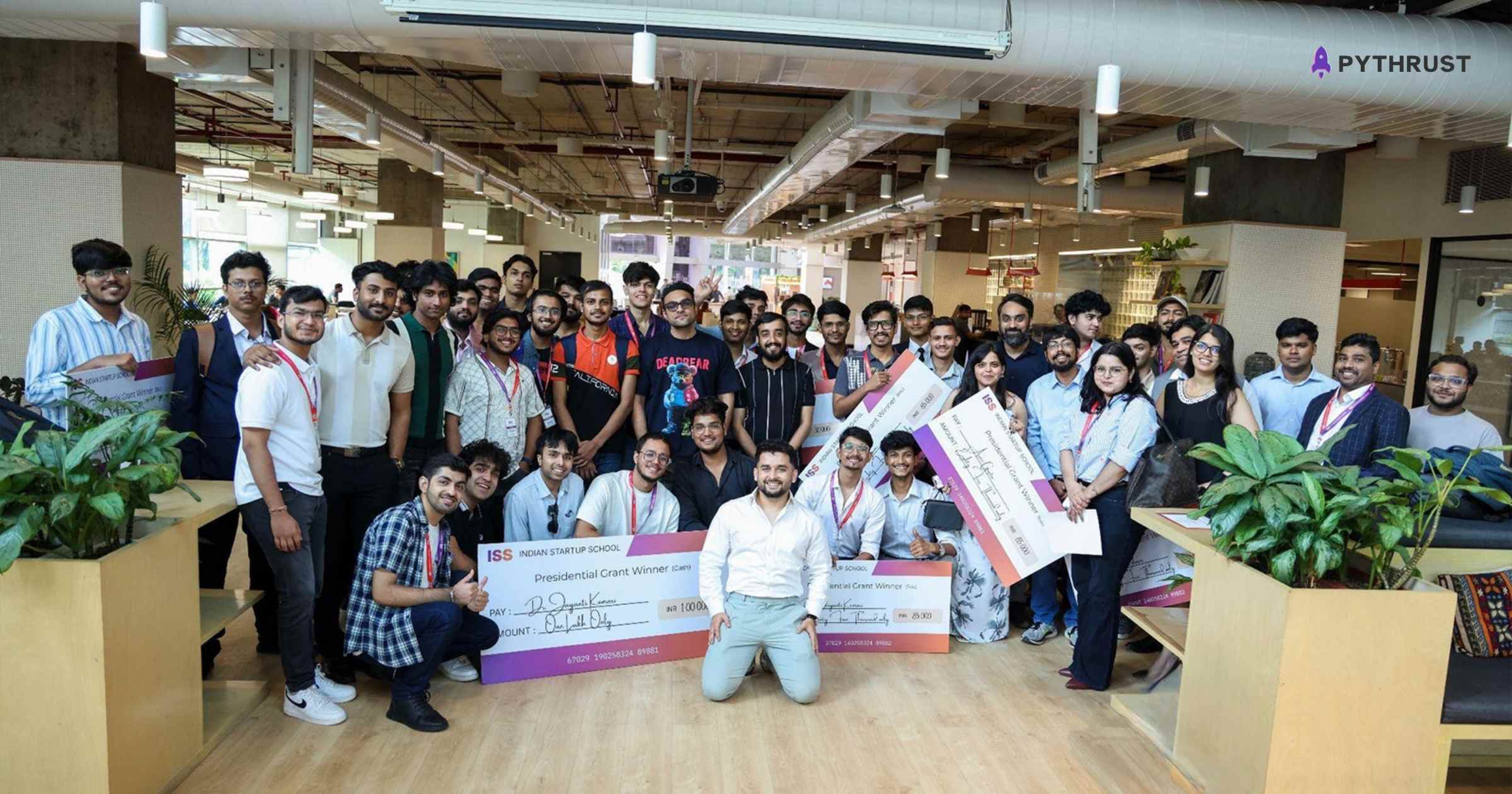
The LMS. Launched to the first batch and presented live to founders in class. Real users, real cohort, day one.
The application and grant funnel. The full apply journey plus the four-step Idea Stage Grant flow, live on the ISS site.
Salesforce lead integration. Every application and grant submission flowed straight into Salesforce, auto-segmented by source, with a lightweight backend built to do what a front-end connection could not.
Email automation. Running directly off Google, with no third-party email platform and no extra licence to buy.
WhatsApp funnel groundwork. The plumbing for WhatsApp-based follow-up, ready to switch on.
The results
Live to the first batch. The LMS was not a demo. Founders used it in class, in the cohort it was built for.
100+ evaluations, doubling as research. The discovery that shaped the product was the same work that advanced ISS’s admissions pipeline. One effort, two outcomes.
Salesforce pipeline live in about a day. What is typically a multi-week API integration was standing up and capturing segmented leads in a day or two.
Zero added tooling cost on email. Automation built on infrastructure ISS already paid for, not a new SaaS line item.
Delivered lean. One tight engagement. No bloated team, no quarter-long discovery, no waiting.
A multi-week Salesforce integration, live in about a day. That is the difference between scoping a product and shipping one.
And the backdrop matters: ISS is playing in a real, competitive market. It has drawn interest from serious investors and national press, including coverage of its founder-first fundraising stance. We build for clients who are playing to win.
Why this matters for you
If you are an early-stage founder or a lean team sitting on a product you cannot get built, this is what working with Pythrust looks like. You bring the ambiguous 70%. We finish the last 30% that actually ships, fast, integrated with what you already run, and informed by your real users. No cathedral specs. No disappearing for a quarter. A working product your users can touch, in the timeframe your business actually has.
Have a product that needs to ship, not just get scoped? Bring us the ambiguous 70%. We finish the last 30% that actually ships. Book a consultation → |


